3 Recruiting Tips for High School Athletes During the NCAA Quiet Period

Take the Initiative — Reach Out to Coaches via Email or Social Media
Even though in-person contact is restricted, coaches can still respond to emails, messages, and letters.

  • Send personalized emails with your highlights, GPA, test scores, and a short message expressing interest.
  • Follow and interact (appropriately) with college programs on platforms like Twitter and Instagram.

Tip: Include a link to your recruiting profile or highlight video in your message.

Update Your Recruiting Profile and Highlight Video
Make sure your Hudl, YouTube, or PrepStar profile is current and polished.

  • Include your latest stats, updated film, and academic info.
  • Coaches will often evaluate from afar during quiet periods, so your online presence is critical.

Tip: Pin your best clips first—coaches often only watch the first 30–60 seconds.

Schedule Unofficial Visits and Campus Tours
You can visit campuses at your own expense, but coaches can’t meet you in person during the quiet period.

  • Take a self-guided tour and get a feel for the campus environment.
  • Snap a picture in school gear and tag the program to show your interest (it keeps you on their radar).

Tip: Check each school’s recruiting calendar to ensure your visit aligns with NCAA rules.
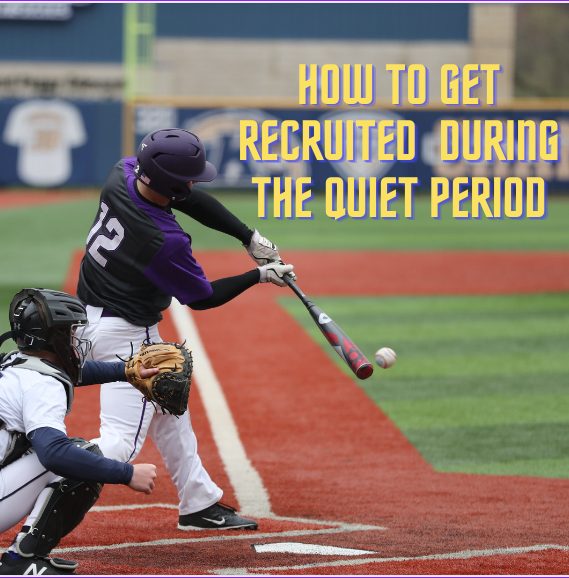
what student athletes can do to improve their recruiting situation during the quiet period

What is the quiet period? What does it mean for recruiting?

According to the NCAA, during a quiet period a college coach may not have face-to-face contact with college-bound student-athletes or their parents, and may not watch student-athletes compete or visit their high schools. Coaches may write and telephone student-athletes or their parents during a dead period.

So, with prospective student athletes, college coaches are not permitted to have; in person evaluations, official campus visits or in person contacts. But, student athletes should be aware that written and telephone communication is permissible during the quiet period. 


Photo by Chris Chow on Unsplash

However, like any other Quiet Period throughout the recruiting calendar, the recruiting process does not stop. Consider the quiet period a time-out from the evaluation process.  

So, student-athletes, what can you do to improve your recruiting situation right now?  

First, get your highlight reel looking sharp. By now you should have a highlights from summer camps, showcases as well as previous seasons, plus some training video. Use this footage to make short highlight and skills videos that can be added to your recruiting profile and viewed by college coaches. 

Next, assess recruiting goals with realistic expectations. If you’ve had your mind set on certain school but have not been contacted by a college coach don’t expect contact anytime soon. Instead, do an honest comparison of your level of play to the quality of athletes being recruited. This will help you determine a good college fit and will also point you to college coaches that you should be contacting. 

Then, expand your methods of contacting college coaches. Don’t just rely on twitter to blast out your video links or show clips of getting one hit during a game. Instead, use multiple points of contact including email, text, and, if you’re brave enough, go old school, by actually making a phone call to a college coach.

Overall, during the quiet period it is important for the student-athlete to stay focused!  The quiet period does not mean that recruiting comes to a dead stop. Lots of recruiting is still to come. 

Is recruiting is going the way you hoped it would? Have questions about the recruiting process? Comment below or DM me. I’m glad to help.

Contact periods for football college coaches and prospective student athletes.

To pick up where we left off last week lets pick up where we left off. During the football season, the NCAA mandates 3 different contact periods for college coaches and prospective student athletes. The first of the two periods work in tandem. Beginning August 1, the Dead Period/ Quite Period is underway. At this time, college coaches may not have face to face contact with athletes or their parents. It also means that college coaches cannot watch players compete UNLESS that student athlete is actually on the college campus for a camp or college visit.

During the high school season, there is another contact period squeezed in September 1 through November 30, 2019

Now, during the season, there is another contact period squeezed in. The exception arrives between the days of September 1 through November 30, 2019. This is the evaluation period. By definition the evaluation period permits college coaches to watch college-bound student-athletes compete, visit their high schools, and write or telephone student-athletes or their parents. However, a college coach may not have face-to-face contact with college-bound student-athletes or their parents off the college’s campus during an evaluation period. 

So, even though coaches can see athletes compete the coaches is not permitted to communicate with the student athlete or their parents. Additionally, coaches are permitted a certain number of evaluation dates depending on the sport.  For example, football coaches are allotted 42 evaluation dates. During those dates, coaches can visit a player once at his or her high school. 

What does this mean for student-athlete seeking to get recruited? First, the primary focus for the athlete should be playing ball. It should go without saying that athletes who are distracted and don’t perform on the field won’t get recruited so limit the distractions and just go play ball.  Second, its important to be patient with the process. The contact periods are designed to slow down the process so that coaches have adequate time to scout prospects. Thirdly, players can, and should, continue reading out to coaches during all contact periods so that they stay on the radar.

Lastly, if your not sure about the ins and outs of the contact period I’m glad to send you free contact period outlines for your sport.. Simply, text “GAMEPLAN” to 480-605-4050 and I’ll send you the sport specific contact period outlines.

The Courtship of College Recruiting


This summer my wife and I will mark our 18th year of beginning together (married for 16 years).  Believe it or not, however, when I first met my wife she did not immediately start dating me. It’s hard to imagine, I know, but we went through several months of courtship before we committed to dating exclusively. Dating and recruiting are a lot alike. There is always a period of time that it takes for a coach and player to get to know one another before making a formal commitment to spend the next 4 years together.


During the recruiting process the relationship developed between a player and coach leads to great commitment.


So, how does dating relate to recruiting?  I’ve outline three steps to communication to grow a solid player/coach recruiting relationship. During that time lots of communication should happen to grow the relationship. Take note, because there are several similarities in process of getting to know the person you’re going to be committed to for the next 4 years.


The first step is to get to know one another. Whether its text, email, Instagram, Twitter, Facebook or SnapChat athletes and coaches need to communicate with one another. Don’t be timid! Healthy relationships grow out of quality conversations. Its okay to be forward, often a coach expresses his/her interests first starting the recruiting communication process by contacting an athlete, viewing their profile or sending an athlete (or family) written correspondence.


The second step is to ask questions. You should ask questions to get the information you are looking for. Keep in mind that you are interviewing a coach, just as much as the coach is interviewing you. Your decision to accept a scholarship offer is contingent on the answers to your questions. Also, keep in mind, coaches solidify relationships by making scholarship offers to players they are comfortable with and confident in.


The third step is to schedule a meeting. Eventually the time will come to decide whether or not to take the relationship to the next level. Real dates happen face to face, not via technology, so its necessary that a time to meet is scheduled. This can be a campus visit, camp, or meeting at your school/home. Point is the communication you’ve had with the coach will determine the chemistry (or lack of) at the face to face meeting.


Lastly, always keep in mind that every relationship takes time. So my advice to you is to give yourself plenty of time to start and grow that relationship. This is a vital because we are well aware that relationships that happen in a hurry often end in a hurry. If you want the relationship between you and your coach to last, you need to invest the time necessary to assure that it will last.


Coach Mike Woosley is a National Scouting Director at CSA-PrepStar.  As a professional collegiatecropped-main_logo-12.jpg sports scout Mike works with qualified next level student-athletes to find the right college athletic and academic fit. Comments and questions are always welcome.

← Back

Thank you for your response. ✨


Proof that Stats Matter

Geometry and Sports

Anyone remember learning how to do proofs in Geometry class? For some of us learning proofs may have happened a long time ago. We learned how to write proofs to show the progressional steps of our work and prove how we arrived at the correct answer. In recruiting it is necessary that you have accurate facts if you are an athletes looking to catch the eye of a coach. Accurate statistical information is an invaluable assets to the recruiting process. Game stats, like proofs, are a series of facts that prove the correct solution to the problem a college coach is looking to solve.

 Stats as a Coaching Tool

Unfortunately, too many high-school coaches do a poor job of keeping and posting accurate stats. When scouting prospective college athletes, I see it everyday. One reason I suspect that coaches don’t keep and post accurate stats is simple; stats can highlight a player’s weakness. A lot of coaches are sympathetic to the athlete and don’t want to make them feel bad about their overall performance. But, good coaching is about helping players accentuate their strengths and work on their weaknesses so that they become strengths!


Glossary of baseball statistics.

Overall, I believe good coaching includes keeping accurate stats because these stats help players become better players! Ultimately, a coach that does not post stats doesn’t help his/her players and consequently does a great deal of harm to the athletes’ prospect status.

 Proofs that Stats Matter

Here are three reasons why stats matter.

  1. First, stats indicate ability to perform. Some athletes are blessed with size or speed. Other athletes have to rely on stats to prove that they have the ability to compete and excel at a high competitive level.
  2. Second, stats provide proof of progress. When an athlete is working on their game stats tend to improve. College coaches use stats to see how you’ve improved your game from week to week and season to season.
  3. Third, stats show strengths and weaknesses. Athletes need to be driven to improve so stats highlight areas to work on. For example, if a batting average that progressively rises shows that you’ve been working on hitting. Or your goal count increases from one season to the next indicates that you’ve been working in the off-season to be more offensively aggressive.

 Stats Show You are the Solution

All in all, stats leave a trail for college coaches to follow to determine if you are the athlete they are looking for. Like your high school geometry teacher grading the steps to your answer college coaches are looking to find players to be solution to their problems. So without accurate, thorough and up-to-date stats college coach may never be able to determine if you are the solution.

Share the Responsibility of Stats

One final word to parents. Most coaches, high school or club, aren’t lazy they have many other responsibility than recording and posting game stats. Many coaches have a profession, teach classes, grade papers and try to maintain family life on top of all the team responsibilities. So, if your high school coach doesn’t post stats parents please step-up and offer to help! It just may make a difference in a student-athlete being passed over and a student-athlete presented with an opportunity for an athletic scholarship.


Coach Mike Woosley is a National Scouting Coordinator at CSA-PrepStar. As a professional collegiate cropped-main_logo-12.jpgsports scout Mike works with qualified next level student-athletes to  find the right college athletic and academic fit.

Avoid the Sophmore Slump with a Focused Recruiting Strategy

sophomoreslumpEver heard of the “Sophomore slump”? In the sporting world the Sophomore year is often the year when performance in the classroom or on the field doesn’t quite meet expectations. How do you avoid the Sophomore slump in recruiting? Simple. All it takes is to be prepared and focused!

For most college sports nearly 85 percent of collegiate athletes are identified by college coaches by the end of their sophomore year. This is true because college coaches can only begin making contact after sophomore year. This means coaches are paying attention to what athletes do Freshman and Sophomore year.  Therefore, the goal with preparation and focus is to get noticed. And to get noticed you have to prepare.

“It’s not the will to win that matters—everyone has that.  It’s the will to prepare to win that matters.”  ~Paul “Bear” Bryant

Prepare

The Sophomore year recruiting strategy is to prepare.

  • Prepare in classroom.
  • Prepare in the weight room.
  • Prepare on the practice field.

Why should you prepare? Because, otherwise, if the Sophomore slump gets to you, the only kind of notice you’ll get from coaches will be disappointment. Conversely, if you want coaches to take note of you, you’ll have to defeat the Sophomore slump with hard work.

Focus

This is the year where the recruiting plan that you put in motion way back in back in Junior high really begins to come into focus. Athletes, the focus should be on putting yourself in position to get noticed by college coaches for your performance in the classroom and in the lineup.  Once again, for most sports, coaches begin to take note of and reach out to contact contact prospective athletes following their sophomore year.

Sophomore Year Recruiting Tips
As a potential collegiate level student athlete you’re sure to be prepared and focused your sophomore year if you keep these recruiting tips in mind.

  • Play up to your potential, avoid the slump.
  • Maintain grades, keeping on track with NCAA core requirements.
  • Research list of potential schools
  • Create a player profile – update it quarterly
  • Start collecting video of game-film and athletic skills footage
  • Record accurate athletic metrics
  • Work towards goal of starting on the varsity team
  • Attend sports camps to continue to improve

Being prepared will help you so say so-long to the sophomore slump. Being prepared will help you get that call or letter of interest after your Sophomore year. So focus on these final recruiting tips is to help you prepare and focus.  Parents and athletes need to know the recruiting timeline. By the time  sophomore year, athletes can receive questionnaire of athletics interest, institutional educational information and camp invites. Personal contact with DI and DII college coaches is not permitted until after your sophomore year.

Want to receive the Elite Athletes blog as your email? Simply click on the follow button above.

Readers are welcome to leave comments to this week’s post or ask questions to be answered in next week’s post.  As always, I can be reached around the clock on twitter @michaelwoosley.

~Coach Mike