Social media has become one of the best ways for student-athletes to connect with college coaches and build recruiting relationships. Unfortunately, it’s also become a favorite tool for scammers and fake accounts. Every year, more athletes receive fraudulent scholarship offers or messages from people pretending to be college coaches.
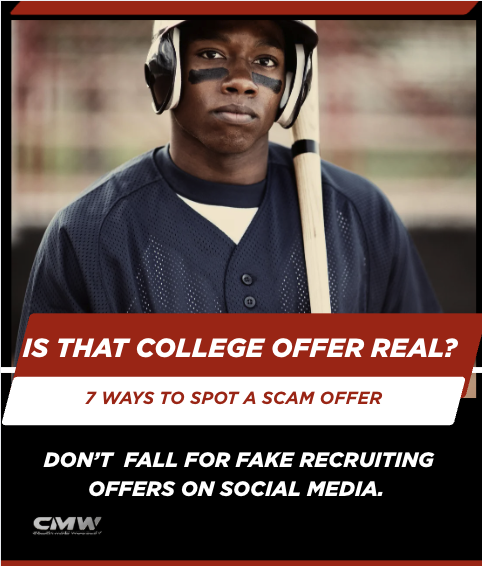
Don’t Fall for Fake Recruiting Offers on Social Media.
Before you celebrate or share an offer online, take a few minutes to verify it’s legitimate.
Visit the college’s athletic website and confirm the coach is listed on the staff directory.
Compare email addresses. A legitimate coach’s email should match the school’s official domain.
Check the sender information. If the message comes from a random email address or suspicious account, proceed with caution.
Read the message carefully. Scammers and bots often use incorrect sport names, graduation years, or awkward wording.
Ask to schedule a phone call. Real coaches are willing to speak with recruits about their interest and the recruiting process.
Never share passwords or account information. Legitimate college coaches will never ask for your login credentials.
Verify before you post. Don’t announce an offer on social media until you’ve confirmed it’s authentic.
A little extra caution can save you from disappointment and protect your recruiting journey. When in doubt, ask a trusted coach, parent, or recruiting advisor to help verify the opportunity before taking the next step.
Every year, I talk with athletes who have the ability to play college sports but aren’t getting the recruiting attention they hoped for. That can be frustrating.Especially when you see other athletes getting calls, visits, offers and social media attention.
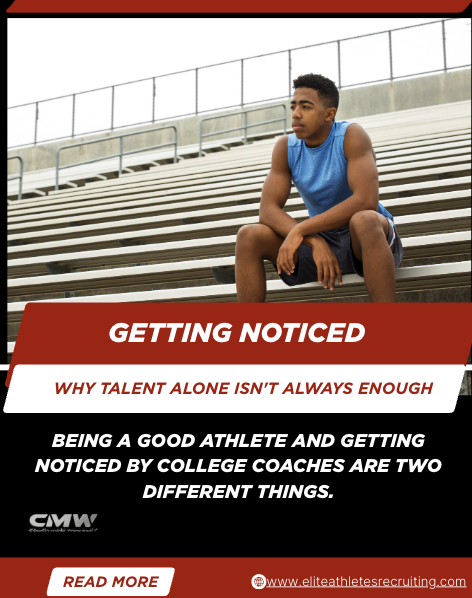
But here’s something every athlete needs to understand: Being a good athlete and getting noticed by college coaches are two different things.
Some athletes have access to tremendous recruiting resources. They attend large schools with successful athletic programs, experienced coaches, private trainers, recruiting services and established relationships with college programs. Other athletes don’t have those same resources.
They may attend a smaller school, play for a program that doesn’t receive much exposure, or simply have to figure out the recruiting process on their own. That doesn’t mean they aren’t capable of playing at the next level. It may mean they need to be more proactive about getting their name in front of the right coaches.
Don’t Wait to Be Discovered
One of the biggest mistakes an athlete can make is assuming that college coaches will eventually find them.
Instead, athletes should learn how to take ownership of the recruiting process. That means learning how to communicate with coaches, ask good questions, research schools and present themselves professionally.
It also means being willing to do things other athletes aren’t doing.
It’s not a complicated strategy. But it does demonstrate something important: Effort.
Get More Recruiting Attention
That’s why I’m hosting a special live webinar:
Get More Recruiting Attention: 5 Ways to Get Noticed
In 60 minutes, I’ll show you practical ways to separate yourself from other athletes and do things that most recruits aren’t doing.
We’ll cover:
How to communicate with college coaches the right way
How to ask the right questions to start conversations
How to properly self-promote without looking weak
How to find colleges that actually fit your academic and athletic goals
How to use AI and social media to help your recruiting
This webinar is especially valuable for athletes who may not have all the resources available to athletes from bigger schools or more successful programs. It’s for the athlete from a smaller school. The athlete whose team doesn’t get a lot of exposure.The athlete who believes they can play at the next level but isn’t getting noticed. And the athlete who wants to take more control of their own recruiting.
See, you don’t need to have every recruiting resource available to you. You need to know what you can do with the resources you have. And sometimes, the difference is simply being willing to do what other athletes aren’t doing.
Join Me Sunday October 4 @ 1pm Pacific
For just $10, you’ll get a 60-minute recruiting webinar focused on practical strategies you can put to work immediately.
And everyone who attends will receive a FREE recruiting profile template that can be used when contacting college coaches.
These four words are at the center of the Recruitable Athlete model.
First, educate. Athletes and parents need to understand how college recruiting actually works. They need to know what college coaches evaluate, what matters at different levels of college athletics, how recruiting timelines work, and what they can control. The more families understand the process, the better decisions they can make.
Next, engage. Education is most valuable when athletes can apply it. Recruiting resources, performance information, checklists, examples, coaching guidance, and consistent content help athletes stay engaged with their development rather than waiting until recruiting becomes urgent.
Then comes evaluate. Every athlete needs to know where they currently stand. An honest evaluation identifies strengths, weaknesses, opportunities, and priorities. It replaces uncertainty with information and gives the athlete a starting point.
Finally, develop. Evaluation only matters if it leads to action. Once the gaps have been identified, the athlete can create a plan to address them. That development might include athletic training, position-specific skill development, recruiting strategy, academic improvement, exposure opportunities, profile development, communication skills, and ongoing accountability.
The process becomes a continuous cycle:
Evaluate → Identify the gaps → Create the plan → Develop the athlete → Re-evaluate.
That is how athletes become more recruitable. And that’s the bigger idea behind the Recruitable Athlete.
You won’t become recruitable by simply hoping a college coach notices you.
You become recruitable by understanding where you are, identifying what needs to improve, developing those areas, and intentionally preparing yourself for the level of college athletics you want to reach.
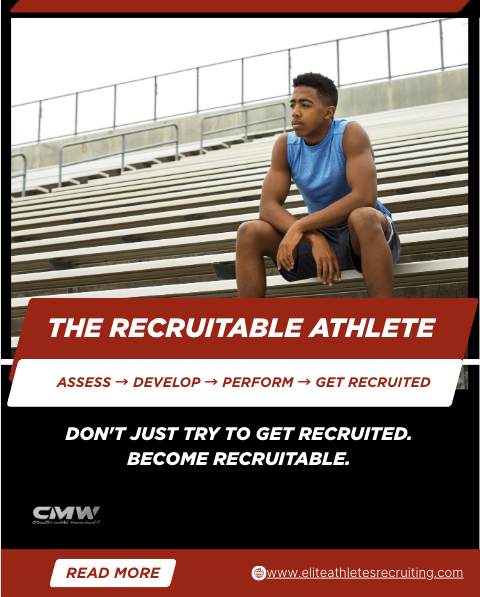
Don’t just try to get recruited. Become recruitable.
PS. Parents and athletes- if you’re already doing the work and being intentional with the process, to become more recruitable, that’s exactly who we help! Get more details @https://pb-site.com/p/LD9mNcrkjN7
For most parents of high school athletes, the desire to play college sports comes with a lot of questions—and often, a lot of uncertainty. You may watch your son or daughter work hard every day and still wonder if they’re actually moving closer to the goal. They may be practicing, lifting weights, playing club sports, attending camps, and competing year-round, but how do you know whether all of that effort is producing the right results? The real question isn’t simply, “Are they working hard enough?” It’s “Are they doing the right things to become a college athlete?”
The Real Problem Parents Are Trying to Solve
When a parent asks, “Is my son or daughter doing enough to play college sports?” they are usually asking a much bigger question. They may be worried that their athlete is working hard but moving in the wrong direction. They may wonder if they’re missing something, whether the athlete is good enough, what they should be working on, whether they’re getting the right exposure, or whether they’re contacting the right schools. They may also be trying to determine what level of college athletics is realistic for their athlete and whether they are waiting too long to get serious about the recruiting process.
And underneath all of those questions is one major fear: “What if my athlete has the ability to play college sports, but we don’t know what to do to get them there?”
That uncertainty can be frustrating for both athletes and parents. It can lead to confusion, wasted time, unnecessary expenses, and missed opportunities. Parents may spend money on camps, showcases, training programs, recruiting services, and travel without knowing whether those activities are actually addressing the athlete’s biggest needs.
Sometimes, the problem isn’t a lack of effort.
It’s a lack of direction.
Effort Isn’t Enough If You Don’t Know What to Improve
Most serious athletes aren’t sitting around doing nothing. They lift weights. They attend practices. They play club sports. They attend camps and showcases. They compete throughout the year. Many of them are incredibly committed to becoming better.
But hard work without evaluation can become wasted effort.
An athlete might spend months getting stronger when their biggest limitation is speed or mobility. They might focus on exposure when their game performance still needs development. They might attend showcase after showcase without having a clear understanding of which college programs are realistic targets. They may even spend countless hours working on their recruiting profile without addressing the athletic or academic deficiencies that are limiting their options.
Working harder isn’t always the answer. Sometimes, the answer is knowing what to work on.
That’s why athlete development should begin with an honest evaluation.
Where are you now? Where do you need to be? What’s the gap between the two? And most importantly, what should you do next?
Those four questions form the foundation of the Recruitable Athlete approach.
PS. Parents and athletes- if you’re already doing the work and being intentional with the process, to become more recruitable, that’s exactly who we help! Get more details @https://pb-site.com/p/LD9mNcrkjN7
For too many athletes, the recruiting process starts with one question: “How do I get recruited?” But a better question is, “What am I doing to become recruitable?” College coaches are looking for athletes who have developed the skills, performance, academics, habits, and personal qualities that make them worth recruiting. This article introduces a different way to approach the recruiting process—one focused not on chasing opportunities, but on intentionally becoming the kind of athlete opportunities find.
Most athletes and parents approach recruiting by asking how to get noticed. They look for college coaches to contact. They search for camps and showcases. They post highlights on social media. They send emails. They try to increase exposure.
Those things can matter. But they are not the starting point. The starting point is the athlete.
Before an athlete can effectively market themselves to college coaches, they need to understand where they currently stand, what college coaches are looking for, and what they need to improve.
That is the difference between simply trying to get recruited and intentionally becoming recruitable.
What Does It Mean to Be Recruitable?
Being recruitable is about much more than athletic ability.
A recruitable athlete is developing the complete package: athletics, academics, communication, branding, knowledge, character and coachability.
Not to mention, a realistic understanding of their college options
The goal isn’t to convince a college coach that an athlete is better than they really are.The goal is to develop the athlete into someone college coaches have a reason to recruit.
That requires an intentional process.
PS. If you’re already doing the work and being intentional with the process, to become more recruitable, that’s exactly who we help! Get more details @https://pb-site.com/p/LD9mNcrkjN7
Over the past several weeks, we’ve explored what it really takes for an athlete to pursue peak performance. The biggest takeaway isn’t that athletes need to train harder, lift more, eat better, or add another recovery tool to their routine. Those things can certainly matter, but none of them are meaningful if they aren’t helping you become a better athlete.
Peak performance starts with honest self-evaluation. Before you can improve, you have to know where you stand. Ask yourself a simple question: Am I actually getting better? It’s easy to confuse being busy with making progress. You can spend hours in the gym, attend camps, work with trainers, and follow the latest training trends, but if your performance isn’t improving, something needs to change.
That’s why measuring your progress matters. The Performance Scorecard gives athletes a way to look beyond effort and evaluate the areas that contribute to becoming a complete athlete. Skill development, strength and conditioning, competitive performance, mental toughness, nutrition, recovery, academics, leadership, recruiting progress, and overall improvement all play a role. You don’t need a perfect score. You need an honest one. (Get your scorecard here: Performance Scorecard)
Once you identify your lowest score, the next step is to turn that weakness into a plan. Don’t try to fix everything at once. Identify the one area that could have the greatest impact on your performance and make it your priority. Create a specific goal, establish measurable actions, and give yourself a timeline. Small improvements, repeated consistently, can eventually create major changes.
But improvement also requires something many athletes struggle with: being willing to accept feedback. Great athletes don’t surround themselves only with people who tell them how good they are. They seek coaches, trainers, teammates, and mentors who are willing to tell them the truth. Constructive criticism isn’t an attack. It’s information. It helps you identify the gap between where you are and where you want to be.
At the same time, athletes have to understand that meaningful improvement takes time. You may not see dramatic results after one workout or one week. Real development happens through repetition, consistency, patience, and accountability. The weakness you’re working on today may eventually become one of your greatest strengths.
That brings us to the main message of this entire series:
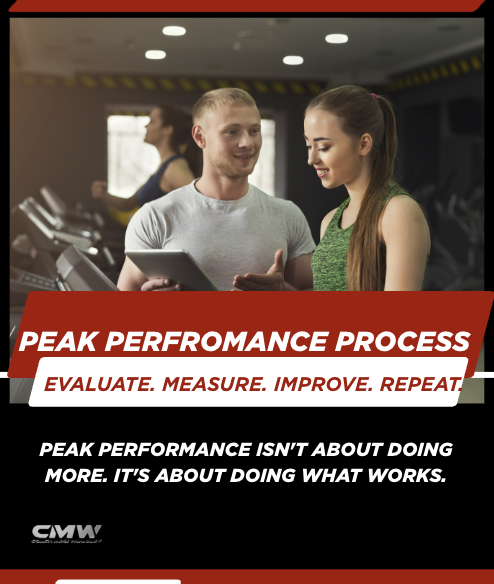
Peak performance isn’t about doing more. It’s about doing what works.
Evaluate yourself honestly. Measure what matters. Identify what needs improvement. Create a plan. Seek feedback. Make adjustments. Then do it again.
This process doesn’t end when the season ends, when you make varsity, or when you reach the next level. Even the best athletes in the world continue to evaluate themselves, study film, listen to coaches, and look for ways to improve.
That’s because peak performance isn’t a destination.
It’s a process.
And that process can be summed up in four simple words:
Evaluate. Measure. Improve. Repeat.
If you’re willing to do those four things consistently, you’re not just working toward becoming a better athlete.
You’re becoming the kind of athlete who is prepared to reach the next level.
Another habit shared by great athletes is their willingness to seek honest feedback. Some athletes avoid criticism because they fear hearing what they’re doing wrong. The best competitors actively pursue it. They ask their coaches what skill needs the most work. They ask trainers where they’re losing efficiency. They review game film with an open mind and accept constructive criticism because they know it provides the fastest path to improvement. Feedback isn’t a personal attack—it’s valuable information that helps close the gap between where you are and where you want to be.
It’s also important to remember that improvement isn’t always immediate. You may not notice dramatic changes after one workout or even one week. Progress often happens gradually, almost unnoticed, until one day you realize that something which used to be a weakness has become one of your greatest strengths. Confidence isn’t built by motivational speeches or social media posts. It grows through preparation, repetition, and seeing the results of your hard work over time.
The truth is that growth never ends. Every time you strengthen one part of your game, another opportunity for improvement will appear. That’s not discouraging—it’s what makes athletics so rewarding. Even professional athletes continue to study film, refine their techniques, and seek coaching. They understand that peak performance isn’t a destination you eventually reach. It’s a lifelong commitment to learning, adapting, and improving.
As you complete this week’s Performance Scorecard, resist the urge to fix everything at once. Instead, identify your lowest score and make it your priority. Write one SMART goal that addresses that weakness. Identify three specific actions you’ll take this week to improve it. Find someone—a coach, teammate, or parent—who can help hold you accountable. Then evaluate your progress again next Sunday.
If you’ve followed this three-part Peak Performance series, you’ve built a blueprint that can guide your athletic development for years to come. First, you learned to evaluate yourself honestly. Next, you learned to measure what truly matters. Now you’ve learned how to turn honest evaluation into purposeful action. Those three habits—evaluation, measurement, and intentional improvement—are what separate athletes who simply work hard from athletes who consistently get better.
Remember, championships aren’t won because someone had one incredible workout or one great game. They’re won because athletes commit to improving a little every day. When you evaluate honestly, measure consistently, and improve intentionally, success stops being a matter of chance. It becomes the natural result of your daily habits.
Last week, we talked about the importance of personal evaluation. The truth is simple: if you’re putting in the work but your performance isn’t improving, something has to change.
This week, we’re taking the next step.
Instead of guessing whether you’re improving, measure it.
The best athletes don’t rely on feelings. They rely on data, consistency, and honest evaluation.
Every Sunday evening, spend 15–20 minutes grading yourself in these ten areas. Over time, you’ll begin to see trends, identify weaknesses, and make adjustments before small problems become big ones.
The Peak Performance Scorecard
Rate yourself from 1–10 in each category.
1 = Needs Significant Improvement
10 = Elite Standard
Don’t inflate your score. Be honest.
1. Skill Development
Ask yourself:
Did I improve a sport-specific skill this week?
Did I spend quality time practicing fundamentals?
Am I more consistent than last week?
Remember, championships are built on fundamentals.
2. Strength & Conditioning
Did your workouts actually make you a better athlete?
Evaluate:
Strength gains
Speed
Agility
Explosiveness
Mobility
The goal isn’t lifting the most weight.
It’s becoming more athletic.
3. Competitive Performance
How did you perform during games or practices?
Consider:
Effort
Decision-making
Consistency
Coachability
Confidence
Your best workouts mean very little if they don’t transfer to competition.
4. Mental Toughness
Elite athletes separate themselves mentally.
Ask yourself:
Did I stay positive after mistakes?
Did I compete through adversity?
Was I focused during practice?
Did I control my emotions?
Mental strength wins close games.
5. Nutrition
Fuel matters.
Grade yourself on:
Hydration
Protein intake
Healthy food choices
Recovery nutrition
You can’t expect high performance from low-quality fuel.
6. Recovery
Improvement happens between workouts.
Evaluate:
Sleep quality
Stretching
Mobility work
Recovery habits
Recovery isn’t being lazy.
It’s preparation for tomorrow.
7. Academic Performance
College coaches recruit students before they recruit athletes.
Track:
GPA
Assignment completion
Class attendance
Study habits
A stronger transcript creates more recruiting opportunities.
8. Leadership & Character
Ask yourself:
Did I encourage teammates?
Was I dependable?
Did I show respect?
Did I lead by example?
Leadership is earned every day—not just on game day.
9. Recruiting Progress
Every week should move you closer to your recruiting goals.
Did you:
Update your recruiting profile?
Email college coaches?
Add new film?
Attend camps?
Respond to coaches?
Waiting isn’t a recruiting strategy.
10. Weekly Improvement
This final category brings everything together.
Ask yourself:
Am I better today than I was last Sunday?
If the answer isn’t clearly “yes,” identify why.
Then fix it.
The Sunday Success Routine
Every Sunday evening, complete your Performance Scorecard.
Then answer these four questions:
What was my biggest win this week?
Celebrate progress.
Where did I struggle most?
Be specific.
What one habit held me back?
Honesty creates improvement.
What one change will I make this week?
Focus on one meaningful adjustment rather than trying to change everything at once.
Your Weekly Performance Score
Add your ten scores together.
90–100: Elite Habits — You’re consistently building championship behaviors.
80–89: Strong Progress — You’re on the right path, but there’s still room to grow.
70–79: Average Performance — Some areas need more intentional focus.
Below 70: Time to Reevaluate — Your current approach isn’t producing the results you want. Identify the lowest scores and make those your priority this week.
Remember, the goal isn’t to earn a perfect score.
The goal is to improve your score every single week.
Success Leaves Clues
Professional athletes review game film.
Businesses track performance metrics.
Championship teams analyze statistics.
Why should your athletic development be any different?
If you aren’t measuring your progress, you’re leaving your development to chance.
The athletes who reach the next level don’t simply train harder.
They evaluate.
They adapt.
They improve.
Every week.
Coach Mike’s Challenge
Print this scorecard or create it in your notebook. (Click here to download)
Set aside 20 minutes every Sunday evening.
Score yourself honestly.
Find your lowest category.
Make one adjustment.
Repeat next week.
Peak performance isn’t built through one incredible workout or one great game.
It’s built through hundreds of small improvements, tracked consistently over time.
Because the athletes who win in the future are the ones who are willing to measure their progress today.
Some athletes need to become stronger and more explosive. Others need better nutrition to maximize their performance. Many struggle to stand out on social media or develop the confidence and mental toughness needed to compete at their highest level.
At Elite Athletes Recruiting, our mission has always been to help student-athletes earn opportunities to compete at the next level. But recruiting success isn’t just about sending emails to college coaches—it’s about becoming the type of athlete coaches want to recruit.
That’s why Coach Mike’s Elite Athlete Performance & Recruiting Coaching focuses on developing the complete student-athlete.
Position-Specific Strength Programs
Generic workouts produce generic results.
Our position-specific strength programs are designed around the physical demands of your sport and position. Whether you’re a quarterback looking to improve rotational power, a lacrosse midfielder building endurance and speed, or a softball player developing explosive power, your training should match your goals.
The right training improves performance, reduces injury risk, and helps you separate yourself from the competition.
Nutrition Coaching & Meal Planning
Training hard is only half the equation.
Without proper nutrition, your body can’t recover, build muscle, or perform consistently. Coach Mike provides practical nutrition guidance and meal planning designed for busy student-athletes and their families.
When your nutrition improves, your energy, recovery, and performance usually improve with it.
Personal Branding on Social Media
Today’s recruiting landscape extends far beyond the field.
College coaches frequently evaluate an athlete’s online presence before making recruiting decisions. A professional social media profile can reinforce your character, work ethic, leadership, and dedication to your sport.
We’ll help you create a personal brand that highlights your accomplishments, showcases your personality, and supports your recruiting goals.
Mental Performance Preparation
Talent wins games.
Mental toughness wins championships.
Learning how to stay confident under pressure, recover from mistakes, remain focused, and compete with discipline are skills that separate good athletes from great ones.
Our mental performance coaching helps athletes develop the mindset needed to perform when it matters most.
Which Area Would Help You Most?
As Coach Mike continues expanding the Elite Athlete Performance & Recruiting Coaching program, we want to build resources that provide the greatest value to student-athletes and their families.
We’d love to hear from you.
Which area interests you the most?
Position-Specific Strength Programs
Nutrition Coaching & Meal Plans
Personal Branding on Social Media
Mental Performance Preparation
Reply with the number that best matches your biggest need, or let us know if there’s another area you’d like Coach Mike to cover.
Together, we’ll build a plan that not only helps you become a better athlete—but also a stronger college recruiting prospect.
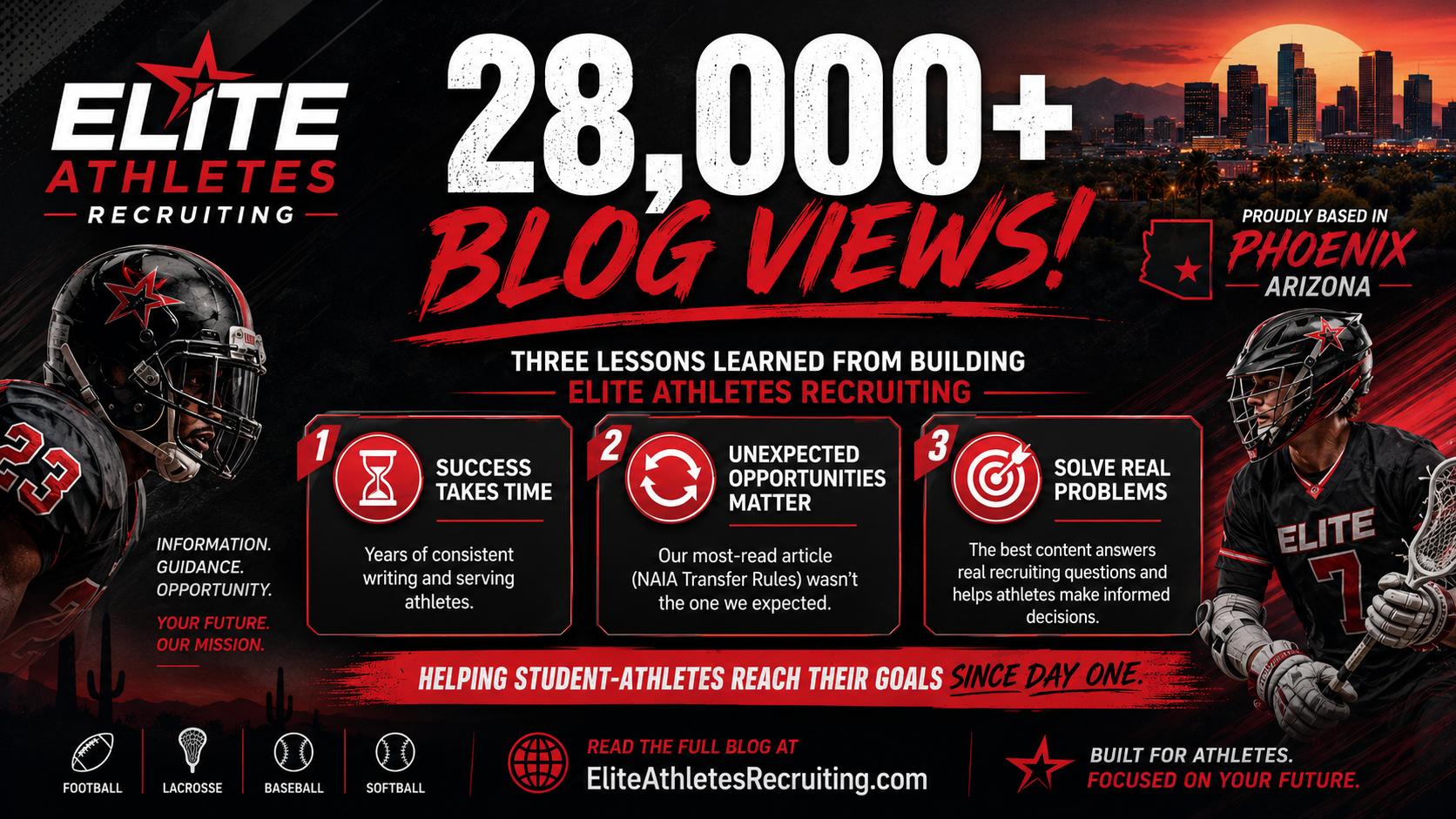
This month, Elite Athletes Recruiting surpassed 28,000 total blog views. While the number itself is exciting, what matters most is that thousands of student-athletes, parents, and coaches have found information that helped them make better decisions during the recruiting journey.
As I reflected on this milestone, three lessons stood out.
1. Success Takes Time
The first lesson is simple: success rarely happens overnight.
I’ve been writing recruiting articles for several years. Some posts gained traction quickly, while others sat quietly for months—or even years—before readers discovered them. Consistent effort, even when results aren’t immediate, compounds over time.
Whether you’re pursuing a college roster spot, building a business, or developing a blog, the principle is the same: keep showing up. The athletes who succeed are often the ones who stay committed long after others quit.
2. Sometimes Unexpected Things Turn Out for the Best
When I wrote that article, I never expected it to become the most-read post on the website. I simply wanted to explain a rule change that could benefit student-athletes.
The lesson? You never know which opportunity, relationship, game, or decision will create the biggest impact. Many times, the things we don’t plan for become the most meaningful. Stay open to opportunities and trust the process.
3. The Best Content Solves Real Problems
Looking at the most-read articles, a pattern emerges. Our readers aren’t searching for motivation alone—they’re searching for answers.
Topics such as transfer rules, eligibility requirements, scholarship opportunities, recruiting timelines, and athlete development consistently attract the most attention because they solve real challenges facing student-athletes and families.
The lesson is valuable both in sports and in life: if you want to make a difference, focus on serving others. Find a problem, provide value, and help people move forward.
Thank you to everyone who has read, shared, and supported Elite Athletes Recruiting over the years. The goal has never been to chase views—it has always been to help student-athletes maximize their opportunities.
Here’s to the next 28,000 views and, more importantly, to helping more athletes achieve their goals. ~ Coach Mike