Development Still Wins in the New Recruiting Landscape

Why the “5-in-5” NCAA Proposal Could Create More Opportunity for High School Athletes

One of the biggest positives of the proposed “5-in-5” eligibility model is that it places value back on development, readiness, and long-term fit.

As recruiting continues to evolve, student-athletes who consistently improve their skills, strength, speed, athleticism, and game IQ throughout high school will continue to separate themselves from the competition. Coaches will always look for athletes who are prepared to contribute, can adapt to college athletics, and will fit the culture of their program.

The new 5-in-5 structure also helps create a more level and predictable recruiting landscape. With clearer timelines and age limits, college programs will have greater roster clarity and fewer long-term logjams created by extended eligibility years. That stability can actually benefit high school recruits.

Another important reality that often gets overlooked is what’s happening at the Division II and Division III levels. While the transfer portal has dramatically impacted college athletics, a high percentage of athletes who enter the portal never find a new school or program fit. As a result, many step away from college athletics altogether, which ultimately creates openings on rosters for incoming high school athletes.

That means opportunities continue to emerge for recruits who stay prepared and continue developing.

The student-athletes who will benefit most from this changing landscape are the ones who stay focused on growth instead of fear. Recruiting has never simply been about hype or rankings—it has always been about finding athletes who are ready, coachable, competitive, and capable of helping a program succeed.

For recruits and their parents, the message remains the same: control what you can control. Develop your game, build strong academics, communicate professionally, and continue improving. Programs at every level are still searching for athletes who are ready for the opportunity when it comes.

Why the NCAA’s “5-in-5” Rule Can Be a Win for High School Recruits

With the NCAA proposing the new “5-in-5” eligibility model, much of the conversation has centered around concern—especially for younger classes like 2028. But while critics focus on what might change, there’s a powerful upside that recruits and families should not overlook. Interestingly, much of the criticism has come from perspectives that tend to focus on the negatives of today’s recruiting landscape—including concerns about travel teams, single-sport specialization, and the financial investment families make in their athletes. That, however, is a broader conversation for another time.

First, opportunity is not disappearing—it’s evolving.

The reality is that college programs will always need talent. No rule change eliminates the demand for skilled, coachable, and hardworking student-athletes. If anything, a more structured eligibility timeline creates greater clarity for coaches when building rosters, which can benefit recruits who are prepared and proactive.

Second, this model encourages intentional recruiting decisions.

Without the flexibility of redshirts and extended eligibility, college programs will prioritize athletes who are truly a fit—athletically, academically, and culturally. For recruits, this means a better chance of landing in a program where they can contribute and develop, rather than being buried on a roster due to logjams created by extra eligibility years.

Third, it places value back on development and readiness.

Athletes who focus on improving their skills, strength, and game IQ throughout high school will stand out. The new structure rewards those who are prepared to compete earlier in their college careers. That’s a positive shift for disciplined athletes who are committed to the process.

Fourth, it creates a more level and predictable recruiting landscape.

In recent years, COVID eligibility, the transfer portal, and NIL have created uncertainty and roster congestion. The “5-in-5” model helps stabilize that environment. With clearer timelines and age limits, recruits and families can plan more effectively and make smarter decisions about camps, showcases, and communication with coaches.

Finally, this is an opportunity to focus on what truly matters: finding the right college fit.

The best outcome in recruiting has never been simply “getting an offer”—it’s finding a program where an athlete can grow, compete, and succeed long-term. This rule change reinforces that mindset.

The Bottom Line

Yes, the landscape is changing. But high school athletes who are willing to put in the work, stay consistent, and approach recruiting with a plan will continue to have opportunities.

The athletes who succeed won’t be the ones worried about the rules—they’ll be the ones who adapt, prepare, and compete.

That’s always been the formula. And it’s not changing anytime soon.

Don’t Coast in the Off-Season: Keep Recruiting Year-Round

The first thing most students want to do when a season ends is relax and take a break. But if you’re an athlete with the goal of playing at the next level, coasting is not the best move. In fact, the off-season or the time between sports seasons is when serious athletes separate themselves from the pack. Instead of taking your foot off the gas, this is the time to rev up the engine and cover some serious ground. Remember, you only have a small four-year window to get seen, scouted, and recruited.

Taking time off can put you behind in both your development and your recruiting. It’s easy to fall into a funk where one day off turns into two, then four, then a week or even a month. College coaches recruit athletes year-round, so you should stay focused on your recruiting year-round as well. The off-season is the perfect time to train, improve your speed and strength, update your highlight video, attend camps, communicate with coaches, and get ahead academically.

So, how do you know if your recruiting is on the right track? Use these guidelines to evaluate your progress.

Freshmen: The recruiting process begins earlier than most athletes realize. As soon as you start high school, you should be building good habits. Focus on grades, strength training, skill development, and creating your first highlight clips. Recruiting truly starts the day you graduate eighth grade, so use your first off-season to build a strong foundation.

Sophomores: This is a pivotal year. Athletes who are on the recruiting radar should start receiving letters, emails, and camp invites. Use the off-season to attend camps, improve your testing numbers, and communicate with coaches.

Juniors: By this stage, you should be hearing from multiple coaches through emails, texts, or camp invitations. The off-season is critical for visits, exposure events, and taking the ACT or SAT. This is your most important recruiting year—make it count.

Seniors: Ideally, you should have been in contact with colleges the summer before your senior year. The goal is to be choosing between opportunities, not hoping for last-minute interest. Use the off-season to follow up with coaches, stay in peak condition, and be ready when opportunities arise.

Follow these guidelines and keep working between seasons, and you’ll put yourself in position to reach the home stretch of your recruiting journey.

One final piece of advice: If your recruiting isn’t going according to plan, get help. The earlier you address the problem, the more options you’ll have. Reach out for a free recruiting evaluation and get your process back on track.

Good luck!

Top 5 Reasons to Consider Junior College Athletics

Junior college can be a smart, strategic step toward your college goals.

A few years ago, I wrote about the value of junior college (JUCO) athletics as an option for high school athletes. At that time, the recruiting landscape was already competitive—but it has changed even more in recent years. The impact of COVID-19, extra eligibility years, and especially the rise of the transfer portal have reshaped recruiting across every level of college sports.

Today, many college programs are filling roster spots with experienced transfers rather than incoming freshmen. As a result, high school athletes are facing more competition than ever before. Because of this shift, junior college is no longer just a backup plan—it can be a smart, strategic step toward reaching long-term athletic and academic goals.

Here are five strong reasons to consider the JUCO route.

1. Cost-Effective College Option

One of the most practical reasons to attend a junior college is affordability. In many cases, tuition at a JUCO is significantly lower than at four-year public or private universities. It is common for junior college tuition to cost only a fraction of what a traditional four-year school charges.

For families concerned about student loan debt, JUCO can provide two years of college credits at a much lower price. When combined with athletic or academic aid, it often becomes one of the most affordable paths to a college degree.

2. Opportunity for Immediate Playing Time

For many athletes, the chance to compete right away is a major factor. At four-year colleges, especially at the Division I level, freshmen often spend their first year or two developing behind older, more experienced players.

At the junior college level, athletes frequently have the opportunity to step into meaningful roles early in their careers. Real game experience is invaluable, and it helps athletes develop the skills, confidence, and maturity needed to compete at higher levels.

Many successful college and professional athletes started at junior colleges, including Aaron Rodgers, Cam Newton, and Warren Moon.

3. A Second Chance in Recruiting

The recruiting process doesn’t always go as planned. Some athletes are overlooked, some develop later, and others simply need more exposure. Junior college gives athletes another opportunity to be recruited.

A strong JUCO season can attract attention from four-year college coaches who are looking for experienced, game-ready players. In today’s transfer-focused environment, coaches often value athletes who have already competed at the college level.

4. Time to Mature Academically and Physically

Not every athlete is ready—academically, emotionally, or physically—to step into a four-year college program right out of high school.

Junior college can provide:

  • Time to improve grades or test scores
  • A smaller campus environment
  • Additional physical development
  • A smoother transition to college life

Many athletes grow stronger, faster, and more confident during their JUCO years. Late bloomers especially benefit from the extra time to develop before moving on to a four-year program.

5. Athletic Scholarships and Competitive Programs

Junior colleges offer a wide range of competitive athletic programs. The National Junior College Athletic Association (NJCAA) oversees hundreds of schools across multiple regions and divisions.

Many JUCO programs offer athletic scholarships, especially at the Division I and Division II levels. When those scholarships are combined with lower tuition costs, junior college becomes a very attractive financial and athletic option.

With hundreds of programs nationwide across multiple sports, there are more opportunities than many families realize.

Final Thoughts

Junior college is no longer viewed as a last-resort option. In today’s recruiting climate, it can be a smart and strategic pathway for athletes who want to continue developing, competing, and pursuing their college goals.

For the right athlete, JUCO offers:

  • Lower costs
  • Immediate playing opportunities
  • A second recruiting window
  • Time to mature and develop
  • Scholarship opportunities

Sometimes the best path to a four-year program—or even a professional career—starts with two strong years at the junior college level.

College Athletic Scholarships By the Name 

Understanding NCAA Athletic Scholarships: Headcount vs. Equivalency Sports

 Not all scholarships are awarded the same way. The NCAA divides sports into two categories: headcount sports and equivalency sports. 

Photo credit, Jeffrey F Lin 

When it comes to college athletics, scholarships play a crucial role in helping student-athletes afford their education while competing at a high level. However, not all scholarships are awarded the same way. The NCAA divides sports into two categories: headcount sports and equivalency sports, with different rules for how scholarships are distributed.

Headcount vs. Equivalency Sports

In headcount sports, such as Division I football (FBS), men’s and women’s basketball, women’s gymnastics, tennis, and volleyball, scholarships are awarded on a full-ride basis. This means each scholarship must cover the full cost of attendance, and there are strict limits on how many athletes can receive one.

In contrast, equivalency sports like baseball, track and field, and soccer allow coaches to divide scholarship funds among multiple players. This means that instead of receiving a full scholarship, many athletes in these sports receive partial scholarships, which are often combined with academic aid or other financial assistance.

Scholarships in Division II and Division III

At the Division II level, all sports are considered equivalency sports, meaning scholarships are typically divided among team members. This allows more athletes to receive financial assistance, but most do not receive full-ride scholarships.

Meanwhile, Division III schools do not offer athletic scholarships at all. However, this does not mean that athletes are left without financial support. Many Division III student-athletes receive substantial aid through academic scholarships, grants, and need-based financial aid. In some cases, the financial packages at Division III institutions can be just as competitive as those in scholarship-granting divisions.

For student-athletes and their families, understanding these distinctions can help in making informed decisions about college recruiting and financial planning. Whether aiming for a full scholarship in a headcount sport, seeking partial aid in an equivalency sport, or leveraging academic scholarships in Division III, there are multiple paths to making college athletics an affordable reality.

The PrepStar featured athlete

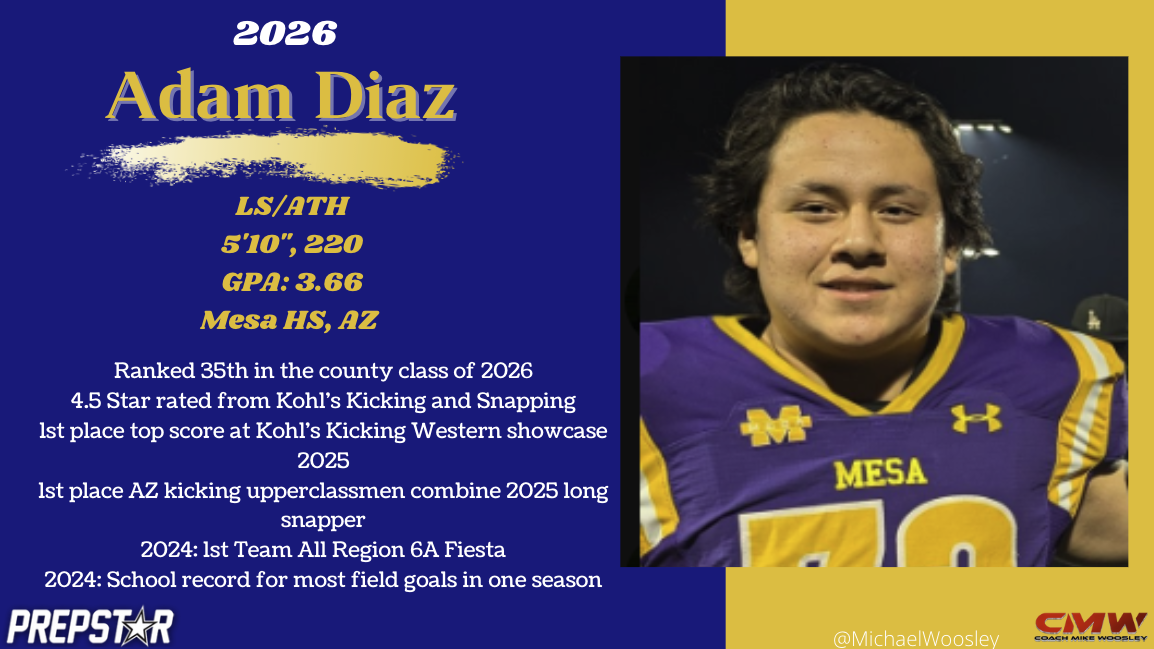
The PrepStar featured athlete for this week is Adam Diaz.  Ranked among the top snappers in the state of Arizona placing 1st place top score at the 2025 Kohl’s Kicking Western Showcase with average snap times of .72 seconds!  Diaz also 1st place AZ Kicking Upperclassmen Combine 2025 for long snappers. Overall, Adam is ranked 35th in the county class of 2026 with a 4.5 star rating. Additionally, he was selected 1st Team All Region 6A Fiesta after the 2024 season. Recently, I caught up with the rising Senior about preparation for the coming season and some memorable moments.

Metrics : Ht: 5’10”, Wt: 220 

Academics : GPA 3.66  

Link to recruit profile: PrepStar 360 Athlete

Link to Hudl: 2024 Season Highlights

Twitter/X: ​​@Diazaj2000

Are you hoping to compete at the next level?

Yes, I am looking forward to competing at college. Since a young age it has been my goal.

What are your academic goals in college (college major)?

I don’t have a specific major picked yet but I think I’m leaning towards engineering. 

What’s the best part of being a student-athlete?

I think the best part of being a student athlete is that it keeps you busy.

What made you start playing your sport?

I started playing it when I was younger and just liked it the more I played

What has been your most unforgettable sports moment?

My most memorable moment was winning the championship the last year of youth football

What’s one thing fans may not know about you?

Fans may not know that I like being a long snapper. I love it! 

Who’s your biggest supporter?

My dad is definitely my biggest supporter. He has been with me for literally every step of my football journey. 

What song gets you pumped up before a game?

I don’t necessarily have a favorite song, it’s more of a genre like indie pop.