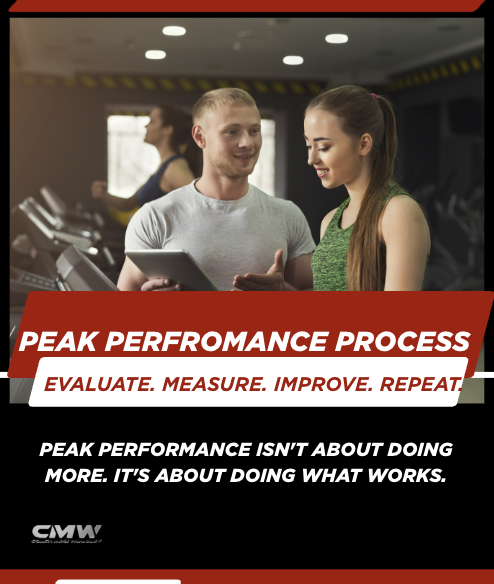
Over the past two weeks, we’ve talked about two of the most important principles of peak performance. First, we discussed the importance of honest self-evaluation. No matter how hard you train, how much you lift, or how disciplined you are with your nutrition, if your performance isn’t improving, something has to change.! Last week, we took that idea a step further by introducing the Weekly Performance Scorecard—a simple tool that allows athletes to measure their progress instead of relying on feelings or assumptions.
This week, we answer the most important question of all: Now what?
Knowing your strengths and weaknesses is only valuable if you’re willing to do something with that information. Too many athletes complete an evaluation, recognize the areas that need improvement, and then go right back to the same routine that produced those results in the first place. Others make the opposite mistake by trying to improve everything at once. They overhaul their workouts, change their diet, add more training sessions, and overwhelm themselves with unrealistic expectations. Neither approach leads to long-term success.
The athletes who improve the fastest understand that progress is rarely about making massive changes overnight. Instead, they focus on one area that will have the greatest impact on their performance and attack it with consistency. They realize that small, intentional improvements repeated week after week eventually produce extraordinary results.
Imagine that you complete your Weekly Performance Scorecard and discover that your lowest score is mental toughness. Everything else is progressing, but your confidence drops after mistakes, you struggle to stay focused under pressure, or you let frustration affect your performance. It’s tempting to say, “I just need to be mentally tougher.” Unfortunately, that’s not a plan. It’s simply a wish.
Successful athletes replace vague goals with specific ones. Instead of saying, “I want to improve my mental toughness,” a more effective goal would be, “Over the next six weeks, I will develop a consistent pre-game routine, practice positive self-talk during every workout, and spend five minutes each evening visualizing successful performances.” That goal is clear, measurable, and gives you a roadmap for improvement.
One of the best ways to create goals that actually lead to progress is by using the SMART goal system. A good goal should be Specific, Measurable, Achievable, Relevant, and Time-Bound. Rather than hoping to get faster, stronger, or more confident, SMART goals define exactly what success looks like and establish a deadline for achieving it. They transform good intentions into daily action.
Of course, even the best goal won’t produce results without a plan. Every Sunday evening, after completing your Performance Scorecard, take a few minutes to map out the week ahead. Decide what you will work on, when you will do it, and how you will measure your progress. If your goal is to improve your first-step explosiveness, your week might include lower-body strength training, acceleration drills, plyometric exercises, and video analysis of your running mechanics. Each workout has a purpose because every workout supports a specific objective.
Perhaps the most difficult lesson for young athletes is learning to focus on just one improvement at a time. In today’s world, social media constantly tells athletes they need to get stronger, faster, quicker, bigger, more explosive, improve their nutrition, perfect their recovery, and master new skills—all at the same time. That approach often leads to frustration because your attention becomes scattered. Elite athletes understand that focused improvement is far more powerful than divided attention. Master one weakness before moving on to the next, and over time you’ll build a complete game. That’s the path to peak performance.