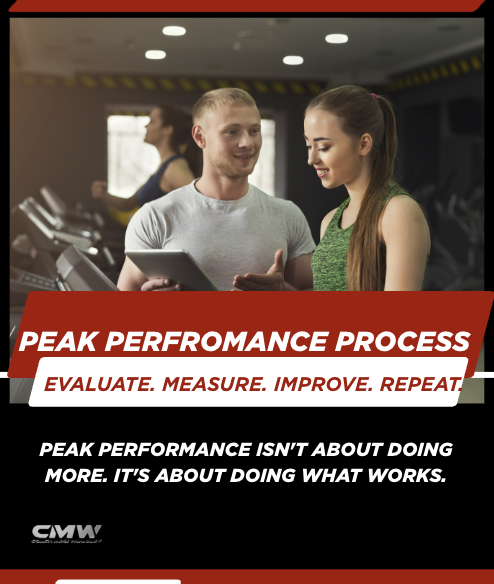
How to Turn Your Lowest Peak Performance Score Into Your Biggest Strength

Over the past two weeks, we’ve talked about two of the most important principles of peak performance. First, we discussed the importance of honest self-evaluation. No matter how hard you train, how much you lift, or how disciplined you are with your nutrition, if your performance isn’t improving, something has to change.! Last week, we took that idea a step further by introducing the Weekly Performance Scorecard—a simple tool that allows athletes to measure their progress instead of relying on feelings or assumptions.

This week, we answer the most important question of all: Now what?

Knowing your strengths and weaknesses is only valuable if you’re willing to do something with that information. Too many athletes complete an evaluation, recognize the areas that need improvement, and then go right back to the same routine that produced those results in the first place. Others make the opposite mistake by trying to improve everything at once. They overhaul their workouts, change their diet, add more training sessions, and overwhelm themselves with unrealistic expectations. Neither approach leads to long-term success.

The athletes who improve the fastest understand that progress is rarely about making massive changes overnight. Instead, they focus on one area that will have the greatest impact on their performance and attack it with consistency. They realize that small, intentional improvements repeated week after week eventually produce extraordinary results.

Imagine that you complete your Weekly Performance Scorecard and discover that your lowest score is mental toughness. Everything else is progressing, but your confidence drops after mistakes, you struggle to stay focused under pressure, or you let frustration affect your performance. It’s tempting to say, “I just need to be mentally tougher.” Unfortunately, that’s not a plan. It’s simply a wish.

Successful athletes replace vague goals with specific ones. Instead of saying, “I want to improve my mental toughness,” a more effective goal would be, “Over the next six weeks, I will develop a consistent pre-game routine, practice positive self-talk during every workout, and spend five minutes each evening visualizing successful performances.” That goal is clear, measurable, and gives you a roadmap for improvement.

One of the best ways to create goals that actually lead to progress is by using the SMART goal system. A good goal should be Specific, Measurable, Achievable, Relevant, and Time-Bound. Rather than hoping to get faster, stronger, or more confident, SMART goals define exactly what success looks like and establish a deadline for achieving it. They transform good intentions into daily action.

Of course, even the best goal won’t produce results without a plan. Every Sunday evening, after completing your Performance Scorecard, take a few minutes to map out the week ahead. Decide what you will work on, when you will do it, and how you will measure your progress. If your goal is to improve your first-step explosiveness, your week might include lower-body strength training, acceleration drills, plyometric exercises, and video analysis of your running mechanics. Each workout has a purpose because every workout supports a specific objective.

Perhaps the most difficult lesson for young athletes is learning to focus on just one improvement at a time. In today’s world, social media constantly tells athletes they need to get stronger, faster, quicker, bigger, more explosive, improve their nutrition, perfect their recovery, and master new skills—all at the same time. That approach often leads to frustration because your attention becomes scattered. Elite athletes understand that focused improvement is far more powerful than divided attention. Master one weakness before moving on to the next, and over time you’ll build a complete game. That’s the path to peak performance.

The Performance Scorecard: 10 Metrics Every Serious Athlete Should Track Weekly

Last week, we talked about the importance of personal evaluation. The truth is simple: if you’re putting in the work but your performance isn’t improving, something has to change.

This week, we’re taking the next step.

Instead of guessing whether you’re improving, measure it.

The best athletes don’t rely on feelings. They rely on data, consistency, and honest evaluation.

Every Sunday evening, spend 15–20 minutes grading yourself in these ten areas. Over time, you’ll begin to see trends, identify weaknesses, and make adjustments before small problems become big ones.

The Peak Performance Scorecard

Rate yourself from 1–10 in each category.

1 = Needs Significant Improvement

10 = Elite Standard

Don’t inflate your score. Be honest.

1. Skill Development

Ask yourself:

  • Did I improve a sport-specific skill this week?
  • Did I spend quality time practicing fundamentals?
  • Am I more consistent than last week?

Remember, championships are built on fundamentals.

2. Strength & Conditioning

Did your workouts actually make you a better athlete?

Evaluate:

  • Strength gains
  • Speed
  • Agility
  • Explosiveness
  • Mobility

The goal isn’t lifting the most weight.

It’s becoming more athletic.

3. Competitive Performance

How did you perform during games or practices?

Consider:

  • Effort
  • Decision-making
  • Consistency
  • Coachability
  • Confidence

Your best workouts mean very little if they don’t transfer to competition.

4. Mental Toughness

Elite athletes separate themselves mentally.

Ask yourself:

  • Did I stay positive after mistakes?
  • Did I compete through adversity?
  • Was I focused during practice?
  • Did I control my emotions?

Mental strength wins close games.

5. Nutrition

Fuel matters.

Grade yourself on:

  • Hydration
  • Protein intake
  • Healthy food choices
  • Recovery nutrition

You can’t expect high performance from low-quality fuel.

6. Recovery

Improvement happens between workouts.

Evaluate:

  • Sleep quality
  • Stretching
  • Mobility work
  • Recovery habits

Recovery isn’t being lazy.

It’s preparation for tomorrow.

7. Academic Performance

College coaches recruit students before they recruit athletes.

Track:

  • GPA
  • Assignment completion
  • Class attendance
  • Study habits

A stronger transcript creates more recruiting opportunities.

8. Leadership & Character

Ask yourself:

  • Did I encourage teammates?
  • Was I dependable?
  • Did I show respect?
  • Did I lead by example?

Leadership is earned every day—not just on game day.

9. Recruiting Progress

Every week should move you closer to your recruiting goals.

Did you:

  • Update your recruiting profile?
  • Email college coaches?
  • Add new film?
  • Attend camps?
  • Respond to coaches?

Waiting isn’t a recruiting strategy.

10. Weekly Improvement

This final category brings everything together.

Ask yourself:

Am I better today than I was last Sunday?

If the answer isn’t clearly “yes,” identify why.

Then fix it.

The Sunday Success Routine

Every Sunday evening, complete your Performance Scorecard.

Then answer these four questions:

What was my biggest win this week?

Celebrate progress.

Where did I struggle most?

Be specific.

What one habit held me back?

Honesty creates improvement.

What one change will I make this week?

Focus on one meaningful adjustment rather than trying to change everything at once.

Your Weekly Performance Score

Add your ten scores together.

90–100: Elite Habits — You’re consistently building championship behaviors.

80–89: Strong Progress — You’re on the right path, but there’s still room to grow.

70–79: Average Performance — Some areas need more intentional focus.

Below 70: Time to Reevaluate — Your current approach isn’t producing the results you want. Identify the lowest scores and make those your priority this week.

Remember, the goal isn’t to earn a perfect score.

The goal is to improve your score every single week.

Success Leaves Clues

Professional athletes review game film.

Businesses track performance metrics.

Championship teams analyze statistics.

Why should your athletic development be any different?

If you aren’t measuring your progress, you’re leaving your development to chance.

The athletes who reach the next level don’t simply train harder.

They evaluate.

They adapt.

They improve.

Every week.

Coach Mike’s Challenge

Print this scorecard or create it in your notebook. (Click here to download)

Set aside 20 minutes every Sunday evening.

Score yourself honestly.

Find your lowest category.

Make one adjustment.

Repeat next week.

Peak performance isn’t built through one incredible workout or one great game.

It’s built through hundreds of small improvements, tracked consistently over time.

Because the athletes who win in the future are the ones who are willing to measure their progress today.

Elevate Your Game: Why Recovery Must Be a Year-Round Performance Standard

Peak performance isn’t built in one great workout. It’s built through daily decisions that allow your body and mind to adapt, grow, and perform at a high level year-round.

Last week, we challenged student-athletes to set a new standard—one built on clear goals, disciplined habits, and daily execution. But goal setting doesn’t stop with training plans or game performance. If you want to truly elevate your game and stand out in the recruiting process, recovery must become part of your ongoing performance goals.

College coaches aren’t just evaluating how hard you train; they’re evaluating durability, consistency, and long-term development. Athletes who recover the right way don’t just improve faster—they stay available, stay explosive, and stay reliable.

Peak performance isn’t built in one great workout. It’s built through daily decisions that allow your body and mind to adapt, grow, and perform at a high level year-round.

Goal #1: Make Sleep a Non-Negotiable Part of Your Training Plan

Sleep is one of the most overlooked performance tools in high school athletics. Yet it’s during sleep that your body repairs muscle tissue, restores energy systems, and locks in the skills you worked on during practice.

If your goals include getting faster, stronger, or more consistent on game day, then 7–9 hours of quality sleep must be part of your standard—not an afterthought. Elite athletes treat sleep like training: it’s scheduled, protected, and prioritized.

From a recruiting standpoint, availability matters. Athletes who recover well are more resilient, miss fewer practices, and show up sharper when it matters most.

Goal #2: Fuel Your Body to Support Performance and Development

Nutrition isn’t about shortcuts or trends—it’s about fueling performance. Set ongoing goals around eating balanced meals that include quality protein, carbohydrates, and healthy fats to support your training load.

Post-workout nutrition is especially critical. What you eat and drink after training directly impacts how quickly you recover, how sore you feel the next day, and how prepared you are for your next session.

College-level athletes understand that consistent fueling equals consistent performance. Hydration, nutrient timing, and recovery meals aren’t optional if your goal is long-term development and visibility in the recruiting process.

Goal #3: Build Active Recovery Into Your Weekly Routine

Recovery doesn’t mean being inactive. Smart athletes use active recovery to stay healthy and athletic throughout the season. Low-intensity activities like walking, cycling, swimming, mobility work, or yoga improve blood flow, reduce stiffness, and enhance flexibility.

Add in recovery tools like foam rolling, stretching, or cold exposure to help manage soreness and maintain movement quality. The key is consistency—active recovery should be planned into your week, not added only when you’re already worn down.

Athletes who move well, recover well, and stay fresh perform better late in seasons—when college coaches are paying close attention.

Recovery Is a Recruiting Advantage

High-level performance is about more than effort—it’s about sustainability. When recovery becomes a continuous goal, you train better, compete harder, and stay healthier across an entire season.

The best student-athletes don’t just chase results; they build systems. Adequate sleep, intentional nutrition, and strategic recovery form the foundation of long-term athletic development and give you a competitive edge in the recruiting process.

Set the standard. Execute it daily. Review it weekly. That’s how goals turn into habits—and habits turn into results that college coaches notice.

The One sport athlete: specializing in a single sport offers significant benefits

The Benefits of Focusing on One Sport

In today’s competitive athletic landscape, many young athletes feel the pressure to participate in multiple sports year-round. While multi-sport participation has its advantages, specializing in a single sport offers significant benefits, including greater skill development, reduced injury risk, and increased opportunities for advancement.

1. Mastery and Skill Development

Focusing on one sport allows athletes to refine their technique, improve fundamentals, and develop a deeper understanding of the game. The additional practice and repetition provide a competitive edge, making athletes more proficient in their specific position or role. With dedicated training, athletes can perfect their mechanics and strategy, leading to a higher level of performance.

2. Increased Repetitions and Competition

As a one-sport athlete, there is an abundant opportunity to get a tremendous amount of reps. Good, quality repetitions are essential for improvement, allowing athletes to fine-tune their movements and enhance muscle memory. Additionally, in sports like baseball, soccer, and softball—where year-round play is possible—one-sport athletes have the advantage of continuous competition. This competition can come from both teammates in practice and opponents in games, pushing athletes to elevate their game.

3. Better Strength and Conditioning

One-sport athletes can follow a training regimen tailored specifically to their sport. This includes strength training, mobility work, and endurance exercises that directly improve performance. A focused training program also helps prevent injuries related to improper training methods or overuse from playing multiple sports.

4. Reduced Risk of Injury

Playing multiple sports can increase the likelihood of overuse injuries due to repetitive strain on different muscle groups and joints. Specializing in one sport allows for a more structured training regimen with proper recovery periods. Athletes can focus on sport-specific strength and conditioning programs that enhance performance while minimizing wear and tear on the body.

5. Increased Opportunities for College Recruitment

College recruiters often seek athletes who demonstrate exceptional ability in one sport. By specializing, athletes can participate in elite-level competition, attend specialized camps, and gain exposure through travel teams or showcases. This focused approach can enhance visibility and improve the chances of securing a scholarship or roster spot at the next level.

6. Stronger Relationships with Coaches and Teams

Athletes who dedicate themselves to one sport can build deeper connections with their coaches and teammates. This consistency fosters a strong support system, effective communication, and a sense of belonging. It also allows coaches to provide personalized feedback and guidance, helping athletes reach their full potential.

7. Mental and Emotional Consistency

Juggling multiple sports can lead to burnout, fatigue, and stress. Specializing in one sport allows athletes to maintain a more balanced lifestyle, with time to focus on academics, personal interests, and recovery. With a clear training schedule, athletes can set realistic goals and track their progress, leading to greater motivation and confidence.

Final Thoughts

While multi-sport participation can help build a broad athletic foundation, specializing in one sport offers distinct advantages for skill development, injury prevention, and career advancement. Each athlete’s journey is unique, and choosing the right path depends on individual goals, passion, and long-term aspirations.