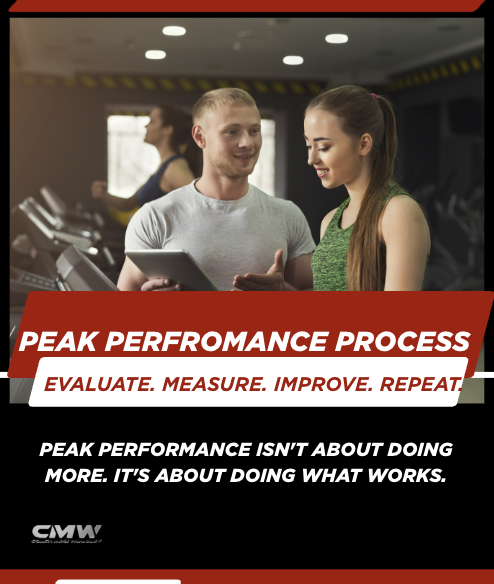
The Peak Performance Process: Evaluate. Measure. Improve. Repeat.

Over the past several weeks, we’ve explored what it really takes for an athlete to pursue peak performance. The biggest takeaway isn’t that athletes need to train harder, lift more, eat better, or add another recovery tool to their routine. Those things can certainly matter, but none of them are meaningful if they aren’t helping you become a better athlete.

Peak performance starts with honest self-evaluation. Before you can improve, you have to know where you stand. Ask yourself a simple question: Am I actually getting better? It’s easy to confuse being busy with making progress. You can spend hours in the gym, attend camps, work with trainers, and follow the latest training trends, but if your performance isn’t improving, something needs to change.

That’s why measuring your progress matters. The Performance Scorecard gives athletes a way to look beyond effort and evaluate the areas that contribute to becoming a complete athlete. Skill development, strength and conditioning, competitive performance, mental toughness, nutrition, recovery, academics, leadership, recruiting progress, and overall improvement all play a role. You don’t need a perfect score. You need an honest one. (Get your scorecard here: Performance Scorecard)

Once you identify your lowest score, the next step is to turn that weakness into a plan. Don’t try to fix everything at once. Identify the one area that could have the greatest impact on your performance and make it your priority. Create a specific goal, establish measurable actions, and give yourself a timeline. Small improvements, repeated consistently, can eventually create major changes.

But improvement also requires something many athletes struggle with: being willing to accept feedback. Great athletes don’t surround themselves only with people who tell them how good they are. They seek coaches, trainers, teammates, and mentors who are willing to tell them the truth. Constructive criticism isn’t an attack. It’s information. It helps you identify the gap between where you are and where you want to be.

At the same time, athletes have to understand that meaningful improvement takes time. You may not see dramatic results after one workout or one week. Real development happens through repetition, consistency, patience, and accountability. The weakness you’re working on today may eventually become one of your greatest strengths.

That brings us to the main message of this entire series:

Peak performance isn’t about doing more. It’s about doing what works.

Evaluate yourself honestly. Measure what matters. Identify what needs improvement. Create a plan. Seek feedback. Make adjustments. Then do it again.

This process doesn’t end when the season ends, when you make varsity, or when you reach the next level. Even the best athletes in the world continue to evaluate themselves, study film, listen to coaches, and look for ways to improve.

That’s because peak performance isn’t a destination.

It’s a process.

And that process can be summed up in four simple words:

Evaluate. Measure. Improve. Repeat.

If you’re willing to do those four things consistently, you’re not just working toward becoming a better athlete.

You’re becoming the kind of athlete who is prepared to reach the next level.

How to Turn Your Lowest Peak Performance Score Into Your Biggest Strength

Over the past two weeks, we’ve talked about two of the most important principles of peak performance. First, we discussed the importance of honest self-evaluation. No matter how hard you train, how much you lift, or how disciplined you are with your nutrition, if your performance isn’t improving, something has to change.! Last week, we took that idea a step further by introducing the Weekly Performance Scorecard—a simple tool that allows athletes to measure their progress instead of relying on feelings or assumptions.

This week, we answer the most important question of all: Now what?

Knowing your strengths and weaknesses is only valuable if you’re willing to do something with that information. Too many athletes complete an evaluation, recognize the areas that need improvement, and then go right back to the same routine that produced those results in the first place. Others make the opposite mistake by trying to improve everything at once. They overhaul their workouts, change their diet, add more training sessions, and overwhelm themselves with unrealistic expectations. Neither approach leads to long-term success.

The athletes who improve the fastest understand that progress is rarely about making massive changes overnight. Instead, they focus on one area that will have the greatest impact on their performance and attack it with consistency. They realize that small, intentional improvements repeated week after week eventually produce extraordinary results.

Imagine that you complete your Weekly Performance Scorecard and discover that your lowest score is mental toughness. Everything else is progressing, but your confidence drops after mistakes, you struggle to stay focused under pressure, or you let frustration affect your performance. It’s tempting to say, “I just need to be mentally tougher.” Unfortunately, that’s not a plan. It’s simply a wish.

Successful athletes replace vague goals with specific ones. Instead of saying, “I want to improve my mental toughness,” a more effective goal would be, “Over the next six weeks, I will develop a consistent pre-game routine, practice positive self-talk during every workout, and spend five minutes each evening visualizing successful performances.” That goal is clear, measurable, and gives you a roadmap for improvement.

One of the best ways to create goals that actually lead to progress is by using the SMART goal system. A good goal should be Specific, Measurable, Achievable, Relevant, and Time-Bound. Rather than hoping to get faster, stronger, or more confident, SMART goals define exactly what success looks like and establish a deadline for achieving it. They transform good intentions into daily action.

Of course, even the best goal won’t produce results without a plan. Every Sunday evening, after completing your Performance Scorecard, take a few minutes to map out the week ahead. Decide what you will work on, when you will do it, and how you will measure your progress. If your goal is to improve your first-step explosiveness, your week might include lower-body strength training, acceleration drills, plyometric exercises, and video analysis of your running mechanics. Each workout has a purpose because every workout supports a specific objective.

Perhaps the most difficult lesson for young athletes is learning to focus on just one improvement at a time. In today’s world, social media constantly tells athletes they need to get stronger, faster, quicker, bigger, more explosive, improve their nutrition, perfect their recovery, and master new skills—all at the same time. That approach often leads to frustration because your attention becomes scattered. Elite athletes understand that focused improvement is far more powerful than divided attention. Master one weakness before moving on to the next, and over time you’ll build a complete game. That’s the path to peak performance.

The Performance Scorecard: 10 Metrics Every Serious Athlete Should Track Weekly

Last week, we talked about the importance of personal evaluation. The truth is simple: if you’re putting in the work but your performance isn’t improving, something has to change.

This week, we’re taking the next step.

Instead of guessing whether you’re improving, measure it.

The best athletes don’t rely on feelings. They rely on data, consistency, and honest evaluation.

Every Sunday evening, spend 15–20 minutes grading yourself in these ten areas. Over time, you’ll begin to see trends, identify weaknesses, and make adjustments before small problems become big ones.

The Peak Performance Scorecard

Rate yourself from 1–10 in each category.

1 = Needs Significant Improvement

10 = Elite Standard

Don’t inflate your score. Be honest.

1. Skill Development

Ask yourself:

  • Did I improve a sport-specific skill this week?
  • Did I spend quality time practicing fundamentals?
  • Am I more consistent than last week?

Remember, championships are built on fundamentals.

2. Strength & Conditioning

Did your workouts actually make you a better athlete?

Evaluate:

  • Strength gains
  • Speed
  • Agility
  • Explosiveness
  • Mobility

The goal isn’t lifting the most weight.

It’s becoming more athletic.

3. Competitive Performance

How did you perform during games or practices?

Consider:

  • Effort
  • Decision-making
  • Consistency
  • Coachability
  • Confidence

Your best workouts mean very little if they don’t transfer to competition.

4. Mental Toughness

Elite athletes separate themselves mentally.

Ask yourself:

  • Did I stay positive after mistakes?
  • Did I compete through adversity?
  • Was I focused during practice?
  • Did I control my emotions?

Mental strength wins close games.

5. Nutrition

Fuel matters.

Grade yourself on:

  • Hydration
  • Protein intake
  • Healthy food choices
  • Recovery nutrition

You can’t expect high performance from low-quality fuel.

6. Recovery

Improvement happens between workouts.

Evaluate:

  • Sleep quality
  • Stretching
  • Mobility work
  • Recovery habits

Recovery isn’t being lazy.

It’s preparation for tomorrow.

7. Academic Performance

College coaches recruit students before they recruit athletes.

Track:

  • GPA
  • Assignment completion
  • Class attendance
  • Study habits

A stronger transcript creates more recruiting opportunities.

8. Leadership & Character

Ask yourself:

  • Did I encourage teammates?
  • Was I dependable?
  • Did I show respect?
  • Did I lead by example?

Leadership is earned every day—not just on game day.

9. Recruiting Progress

Every week should move you closer to your recruiting goals.

Did you:

  • Update your recruiting profile?
  • Email college coaches?
  • Add new film?
  • Attend camps?
  • Respond to coaches?

Waiting isn’t a recruiting strategy.

10. Weekly Improvement

This final category brings everything together.

Ask yourself:

Am I better today than I was last Sunday?

If the answer isn’t clearly “yes,” identify why.

Then fix it.

The Sunday Success Routine

Every Sunday evening, complete your Performance Scorecard.

Then answer these four questions:

What was my biggest win this week?

Celebrate progress.

Where did I struggle most?

Be specific.

What one habit held me back?

Honesty creates improvement.

What one change will I make this week?

Focus on one meaningful adjustment rather than trying to change everything at once.

Your Weekly Performance Score

Add your ten scores together.

90–100: Elite Habits — You’re consistently building championship behaviors.

80–89: Strong Progress — You’re on the right path, but there’s still room to grow.

70–79: Average Performance — Some areas need more intentional focus.

Below 70: Time to Reevaluate — Your current approach isn’t producing the results you want. Identify the lowest scores and make those your priority this week.

Remember, the goal isn’t to earn a perfect score.

The goal is to improve your score every single week.

Success Leaves Clues

Professional athletes review game film.

Businesses track performance metrics.

Championship teams analyze statistics.

Why should your athletic development be any different?

If you aren’t measuring your progress, you’re leaving your development to chance.

The athletes who reach the next level don’t simply train harder.

They evaluate.

They adapt.

They improve.

Every week.

Coach Mike’s Challenge

Print this scorecard or create it in your notebook. (Click here to download)

Set aside 20 minutes every Sunday evening.

Score yourself honestly.

Find your lowest category.

Make one adjustment.

Repeat next week.

Peak performance isn’t built through one incredible workout or one great game.

It’s built through hundreds of small improvements, tracked consistently over time.

Because the athletes who win in the future are the ones who are willing to measure their progress today.

Peak Performance Starts with the Truth: Why Every Athlete Needs a Personal Evaluation

Every athlete wants to perform at their highest level. They spend hours in the weight room, train with private coaches, buy the latest recovery tools, follow nutrition plans, and scroll through social media looking for the next secret to gaining an edge.

But here’s the question that matters most:

Are you actually getting better?

It’s a simple question that surprisingly few athletes ask themselves honestly.

Activity Isn’t Progress

Today’s athletes have access to more information, training methods, and technology than ever before. Yet many confuse being busy with becoming better.

You can:

  • Lift weights six days a week.
  • Run speed drills every morning.
  • Eat perfectly.
  • Sleep eight hours a night.
  • Spend hundreds or even thousands of dollars on trainers and camps.

None of those things guarantee improvement.

If your performance on the field, court, or track isn’t improving, then something needs to change.

The goal isn’t to become a better weightlifter.

The goal isn’t to become a better gym athlete.

The goal is to become a better football player, basketball player, softball player, soccer player, or lacrosse player.

Everything else is simply a tool to help you get there.

Stop Chasing Trends

Social media has made it easy to believe that every new workout, supplement, or recovery gadget is the missing piece.

The truth?

There is no shortcut around honest evaluation.

Some athletes spend more time filming workouts than studying game film.

Others obsess over vertical jump numbers while ignoring their shooting percentage, tackling technique, first touch, or decision-making.

Peak performance isn’t about looking like an athlete.

It’s about performing like one.

Ask Yourself the Hard Questions

Real growth begins when you’re willing to be brutally honest with yourself.

Ask yourself:

  • Am I better today than I was three months ago?
  • What specific part of my game has improved?
  • What still holds me back?
  • What skills have I avoided because they’re difficult?
  • Do I train with purpose or simply follow a routine?
  • Is my training transferring to competition?

These questions aren’t meant to discourage you.

They’re designed to give you direction.

Measure What Matters

The best athletes don’t guess.

They measure.

Instead of saying, “I’m working hard,” ask:

  • Has my sprint time improved?
  • Am I stronger in ways that help my sport?
  • Am I making better decisions during competition?
  • Have my statistics improved?
  • Do my coaches trust me with bigger roles?
  • Am I becoming more consistent under pressure?

If you can’t measure improvement, it’s difficult to know whether your plan is working.

Change Isn’t Failure

One of the biggest mistakes athletes make is sticking with a plan simply because they’ve invested time in it.

If your current approach isn’t producing results, changing your plan isn’t quitting.

It’s adapting.

Champions constantly evaluate.

They make adjustments.

They seek feedback.

They improve.

Peak Performance Requires Reflection

The athletes who reach the next level aren’t always the most talented.

They’re often the ones willing to look in the mirror, identify weaknesses, and make intentional changes.

Every practice.

Every workout.

Every game.

Every season.

Ask yourself one question:

“Is what I’m doing helping me become a better player?”

If the answer is yes, keep going.

If the answer is no, have the courage to make a change.

Because peak performance doesn’t come from doing more.

It comes from doing what works.


Coach Mike’s Challenge

This week, set aside 30 minutes with a notebook and honestly evaluate yourself.

Write down:

  • Three areas where you’ve improved.
  • Three areas that still need work.
  • One habit that’s helping your development.
  • One habit that’s holding you back.
  • One change you’ll commit to making this week.

Remember, the athletes who improve the fastest aren’t always the ones who work the hardest.

They’re the ones who are honest enough to evaluate themselves, humble enough to accept feedback, and disciplined enough to make changes.

That’s how peak performance is built.

One honest evaluation at a time.