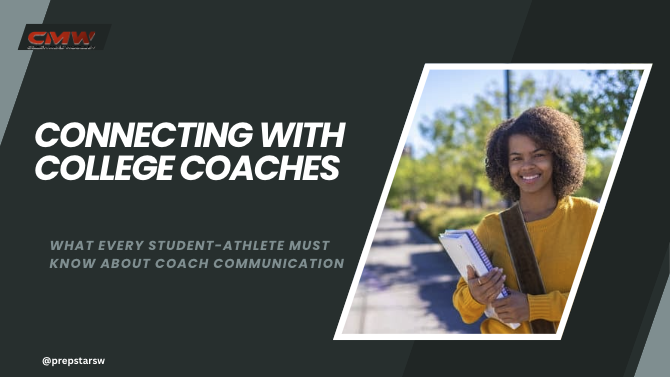
Connecting with College Coaches: Five Tips Every Student-Athlete Should Follow

Connecting with college coaches is one of the most important steps in the recruiting process—and one of the most misunderstood. Many student-athletes assume coaches will simply “find” them. In reality, recruiting is a proactive process that rewards preparation, communication, and persistence.

To increase your chances of building meaningful connections with college coaches, focus on the following five proven strategies.

1. Research Potential Schools

Before reaching out to any coach, take the time to research schools that align with both your athletic and academic goals. Look beyond the name on the jersey. Consider the level of competition, the coaching staff and their recruiting history, training facilities, and the quality of academic programs that support your long-term career plans. Targeting the right schools from the start leads to stronger conversations and better recruiting outcomes.

2. Reach Out to Coaches

Don’t wait for a coach to contact you—initiate the conversation. Email, social media, text messages, and phone calls are all tools athletes can use to express interest. Effective communication should highlight not only your athletic ability but also your desire to earn a college education and contribute to the program. Personalized, respectful outreach shows maturity and genuine interest, which coaches value.

3. Link Your Recruit Profile

Your recruiting profile acts as your sports resume. A PrepStar recruit profile provides college coaches with a clear snapshot of who you are as an athlete and student, including statistics, academic information, achievements, and personal details. Always include your profile link when contacting coaches. You can find your link by clicking the Settings button on the Scoreboard homepage, making it easy to share with every coach you contact.

4. Stay Active on Social Media

Social media matters in recruiting. College coaches regularly review a recruit’s online presence to learn more about their character, habits, and behavior. Stay active, positive, and professional. Share training updates, game highlights, and academic achievements while avoiding posts that could raise red flags. Think of social media as an extension of your recruiting profile.

5. Be Persistent and Patient

Recruiting is rarely an overnight process. Coaches manage hundreds of prospects and tight recruiting calendars, so responses may not come immediately. Stay patient, follow up appropriately, and continue developing your skills both on and off the field. Consistent effort, strong communication, and steady improvement often separate recruited athletes from those who get overlooked.

Final Thoughts

Connecting with college coaches requires a plan, consistent action, and the right tools. By researching schools, reaching out confidently, sharing your PrepStar recruit profile, managing your social media presence, and staying persistent, you put yourself in control of your recruiting journey.

Preparation creates opportunity—and opportunity leads to results.

How Homeschooled Athletes Can Qualify for College Sports

Homeschooling continues to rise across the country. In the 2022–23 school year, about 3.4% of all K–12 students in the U.S. — roughly 3 to 4 million — were homeschooled, up from around 2.8% in 2018–19. With more families choosing home education for flexibility, faith, or focus on athletics, many homeschool athletes are now setting their sights on competing at the next level.

The path to college sports is absolutely open for homeschool athletes — it just takes organization, preparation, and understanding the NCAA eligibility process.

Start by creating your Student-Athlete Account at the NCAA Eligibility Center. This is your official starting point for NCAA verification and where you’ll upload your transcript, course details, and proof of graduation.

Next Build a Complete Homeschool Transcript. The transcript should list all courses, grades, and credits earned and be signed and dated by your homeschool administrator (usually a parent). This serves as your official record of academic achievement.

Then, Provide Course Descriptions and Meet NCAA Core Standards. Each course needs a brief outline that includes textbooks, grading methods, and objectives. The NCAA requires 16 core courses in English, math, science, and social studies, so make sure your curriculum matches those expectations.

Along the way, keep detailed records. Save syllabi, graded work, and reading lists. The NCAA may request additional documentation, and staying organized will make the process much smoother. Student athletes will need to submit proof of graduation. So, a homeschool diploma or written statement confirming your graduation date completes your eligibility file.

Throughout your high school care it is important to compete, so get on the field and get noticed!

Join a homeschool athletic association, club program, or — where allowed — your local public school team to gain competitive experience. Exposure is key to being recruited by college coaches.

Coach’s Tip: PrepStar has helped thousands of student-athletes, including homeschoolers, get seen and recruited by college coaches nationwide. If you’re homeschooled and ready to take the next step toward your college recruiting journey follow my IG page- homefieldadvantagehq – our page to help homeschool athletes reach the next level.

College Athletic Scholarships By the Name 

Understanding NCAA Athletic Scholarships: Headcount vs. Equivalency Sports

 Not all scholarships are awarded the same way. The NCAA divides sports into two categories: headcount sports and equivalency sports. 

Photo credit, Jeffrey F Lin 

When it comes to college athletics, scholarships play a crucial role in helping student-athletes afford their education while competing at a high level. However, not all scholarships are awarded the same way. The NCAA divides sports into two categories: headcount sports and equivalency sports, with different rules for how scholarships are distributed.

Headcount vs. Equivalency Sports

In headcount sports, such as Division I football (FBS), men’s and women’s basketball, women’s gymnastics, tennis, and volleyball, scholarships are awarded on a full-ride basis. This means each scholarship must cover the full cost of attendance, and there are strict limits on how many athletes can receive one.

In contrast, equivalency sports like baseball, track and field, and soccer allow coaches to divide scholarship funds among multiple players. This means that instead of receiving a full scholarship, many athletes in these sports receive partial scholarships, which are often combined with academic aid or other financial assistance.

Scholarships in Division II and Division III

At the Division II level, all sports are considered equivalency sports, meaning scholarships are typically divided among team members. This allows more athletes to receive financial assistance, but most do not receive full-ride scholarships.

Meanwhile, Division III schools do not offer athletic scholarships at all. However, this does not mean that athletes are left without financial support. Many Division III student-athletes receive substantial aid through academic scholarships, grants, and need-based financial aid. In some cases, the financial packages at Division III institutions can be just as competitive as those in scholarship-granting divisions.

For student-athletes and their families, understanding these distinctions can help in making informed decisions about college recruiting and financial planning. Whether aiming for a full scholarship in a headcount sport, seeking partial aid in an equivalency sport, or leveraging academic scholarships in Division III, there are multiple paths to making college athletics an affordable reality.

The PrepStar featured athlete

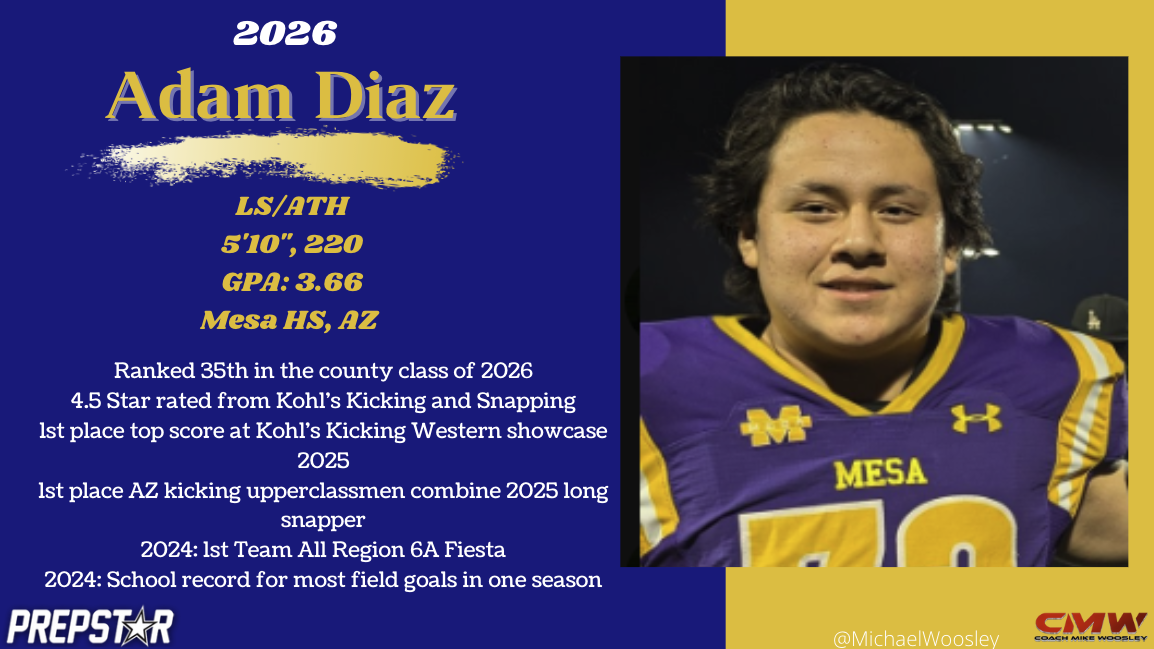
The PrepStar featured athlete for this week is Adam Diaz.  Ranked among the top snappers in the state of Arizona placing 1st place top score at the 2025 Kohl’s Kicking Western Showcase with average snap times of .72 seconds!  Diaz also 1st place AZ Kicking Upperclassmen Combine 2025 for long snappers. Overall, Adam is ranked 35th in the county class of 2026 with a 4.5 star rating. Additionally, he was selected 1st Team All Region 6A Fiesta after the 2024 season. Recently, I caught up with the rising Senior about preparation for the coming season and some memorable moments.

Metrics : Ht: 5’10”, Wt: 220 

Academics : GPA 3.66  

Link to recruit profile: PrepStar 360 Athlete

Link to Hudl: 2024 Season Highlights

Twitter/X: ​​@Diazaj2000

Are you hoping to compete at the next level?

Yes, I am looking forward to competing at college. Since a young age it has been my goal.

What are your academic goals in college (college major)?

I don’t have a specific major picked yet but I think I’m leaning towards engineering. 

What’s the best part of being a student-athlete?

I think the best part of being a student athlete is that it keeps you busy.

What made you start playing your sport?

I started playing it when I was younger and just liked it the more I played

What has been your most unforgettable sports moment?

My most memorable moment was winning the championship the last year of youth football

What’s one thing fans may not know about you?

Fans may not know that I like being a long snapper. I love it! 

Who’s your biggest supporter?

My dad is definitely my biggest supporter. He has been with me for literally every step of my football journey. 

What song gets you pumped up before a game?

I don’t necessarily have a favorite song, it’s more of a genre like indie pop.

Keys to Connecting with College Coaches: 5 Tips for High School Athletes

How High School Athletes Can Successfully Connect with College Coaches

The recruiting process can feel overwhelming, especially when you’re trying to stand out and make real connections with college coaches. If you’re a student-athlete looking to take the next step in your athletic and academic journey, here are five essential tips to help you build relationships with college coaches and get noticed.

1. Do Your Homework on Schools

Start by researching colleges that fit your athletic level and academic goals. Look into the team’s performance, coaching staff, facilities, academic support, and overall campus environment. The more you know, the better you can target schools where you’ll be a strong fit—and show genuine interest when you contact coaches.

2. Initiate Contact with Coaches

Don’t wait to be discovered—take the first step. Send a well-written email or direct message introducing yourself and explaining why you’re interested in their program. Be polite, professional, and personal. Mention specific reasons why you admire the school and team. Follow up with a short phone call or text if appropriate. Coaches appreciate athletes who take initiative.

3. Share Your Recruiting Profile

Make it easy for coaches to evaluate you by including a link to your PrepStar recruit profile in your messages. Your profile should highlight your athletic achievements, stats, GPA, test scores, and a short bio. You can find your profile link by clicking the Settings button on your Scoreboard homepage. A strong, updated profile helps coaches get to know you quickly.

4. Use Social Media the Right Way

Your social media can be a powerful recruiting tool—or a red flag. College coaches often review athletes’ profiles to learn more about their personality and behavior. Post highlights, training clips, and positive content that reflects your work ethic and character. Clean up anything that might raise concerns.

5. Be Consistent and Stay Patient

Recruiting takes time. You might not hear back right away, and that’s okay. Keep training, improving your skills, and staying in touch with coaches. Send updates when you have new highlights or achievements. Persistence shows dedication, and the right opportunity will come with consistent effort.

Final Thought:
Connecting with college coaches is about being proactive, professional, and prepared. Stay focused, stay positive, and keep showing coaches that you’re ready—both on and off the field.

College Athletic Scholarships By the Numbers 

Here’s an overview of athletic scholarships available across NCAA Division I, Division II, and Division III:

Division I

  • Sports Sponsored: Division I schools offer the most scholarships due to the larger athletic budgets and higher revenue sports like football and basketball.
  • Athletic Scholarships: Approximately 138,500 full or partial athletic scholarships are available in Division I.

Division II

  • Athletic Scholarships: Approximately 36,500 scholarships are awarded in Division II.
  • Sports Sponsored: While scholarships are fewer compared to Division I, athletes often receive partial scholarships combined with academic aid or need-based grants.

Division III

  • Athletic Scholarships: None (officially).
  • Key Notes:
    • Division III schools do not offer athletic scholarships, but athletes often receive substantial financial aid packages, including academic scholarships, grants, and need-based aid.
    • Many Division III athletes receive support comparable to what is offered in scholarship-granting divisions.

Key Notes:

  • Headcount sports (e.g., football, basketball, women’s gymnastics, tennis, and volleyball) provide full scholarships.
  • Equivalency sports (e.g., baseball, track and field, soccer) allow coaches to divide scholarships among multiple athletes.
  • All sports in Division II are considered equivalency sports, meaning scholarships are often split among team members.
  • Division III schools do not offer athletic scholarships, but athletes often receive substantial financial aid packages, including academic scholarships, grants, and need-based aid.
  • Many Division III athletes receive support comparable to what is offered in scholarship-granting divisions.