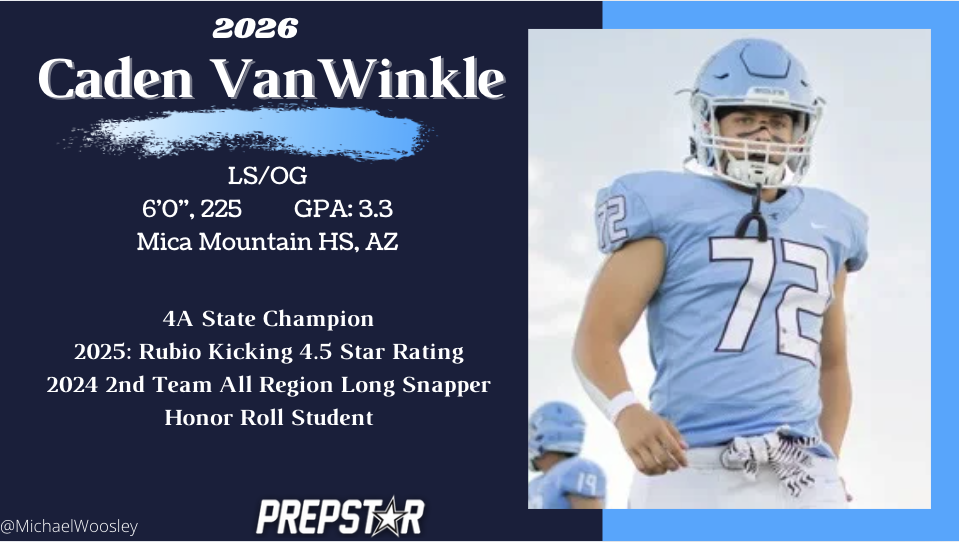
The PrepStar featured athlete for this week is Caden VanWinkle. Caden is a dual-position, dual-sport athlete from Mica Mountain High School in Tucson, AZ. He is considered among the top snappers in the state of Arizona and ranked as a 4.5 Star by Rubio Kicking. When he is not snapping for the special teams unit, Caden is getting dirty in the trenches as an offensive linemen. After the 2024 season VanWinkle was selected 2nd Team All Region. He is also an Honor Roll student and a member of the wrestling team. This summer he picked up his first D1 offer from UTEP (University of Texas El Paso). Recently, I caught up with the rising Senior about preparation for the coming season and some memorable moments.
The PrepStar featured athlete for this week is Damir Ilicic. Ilicic is a read option dual threat quarterback with good size, speed, and a big arm. In 2024, as a Junior, Damir threw for 2,237 yards with 21TDs! Additionally, he was selected 1st Team All Region. Recently, I caught up with the rising Senior about preparation for the coming season and some memorable moments.
Metrics: 6’2”, 180 Academics: GPA 4.0
Link to recruit profile: PrepStar 360 Athlete Link to Hudl: 2024 Season Highlights Twitter/X: @damirtilicic
What made you fall in love with your sport? After I came to the United States I thought football looked so fun and entertaining, so I started playing and fell in love with it!
What motivates you to keep pushing yourself? To be a better player and person everyday!
What’s your dream school to play for? I would love to play at an Ivy League school like Dartmouth or Cornell. I believe that’s truly where I belong to play!
What’s the best advice you’ve gotten from a coach? The game is 20 percent physically and 80 percent mentally, it really changed my perspective on the fact that my mental game will take me further than my physical attributes.
What part of the game do you enjoy the most? The team is my favorite part of the game.
What do you want to be remembered for as a teammate? I would like to be remembered as someone who truly cared about everyone and that changed the program for the better.
How do you prepare before a game? I usually prepare for the game by eating a lot of carbs the night before. I also watch a whole lot of film on the opponent throughout the game week.
What has been your favorite in-game moment? My favorite in game moment had to be this past homecoming game, the throw to end the first half of the game really sealed the deal.
If a movie was made about you, who would star? Leonardo DiCaprio, I just think he resembles me a whole lot.
If you could play another sport, what would it be? I would like to play soccer, I used to play and it was fun when I did play.
The PrepStar featured athlete for this week is Jenna Layton. The outstanding volleyball athlete was a 2024 Sports360AZ All-Academic Girls Volleyball (4A-6A) selection as a libero and defensive specialist. On the court she brings a high level of intensity, court awareness, and leadership to the Walden Grove High School team. Recently, I caught up with the rising Senior about preparation for the coming season and some memorable moments.
My goals for after high school is to play collegiate volleyball and to study sports medicine. I plan on getting my doctorate in athletic training and major in kinesiology.
Who or what inspires you to keep working hard?
What inspires me to continue to work hard is the mindset to be the best me in anything that I do, if that’s in volleyball or in my schooling or even as a person. I want to strive to continue to be better in areas that I’m already good in and to get better in the areas that I struggle.
What’s one skill you’re working on this season?
One skill I would like to work on this season is my serve receive and getting it down to a tea. I realize within myself that it’s an area of performance that I know I need to try and perfect.
What’s been your biggest accomplishment in your athletic career?
My biggest accomplishment in my athletic career would be making varsity as a sophomore or winning our preseason tournament leading into my junior high school season.
How do you handle pressure or adversity?
How I handle pressure or adversity is by trying to forget the point before. If I mess up I forget about it and not let it dwell my performance the rest of the game. I also try to make sure I’m having fun when I play to help limit the pressure I feel.
What do you want to be remembered for as an athlete?
What I would like to be remembered for as an athlete is not only my performance but how I am as a teammate and being able to run the back row when I play. I want to be known as the teammate that lifts everyone up and brings the energy to the court.
If you could play any other sport, what would it be?
If I could play any other sport it would be softball. I grew up in a softball/baseball family and I do have interest in it. I also played softball when I was younger and was pretty good.
What’s your pre-game hype song?
Honestly I don’t have a specific song. I think any song that brings up the energy and gets me into the mood. Preferably Drake, 21 Savage or Kendrick.
Who’s your favorite pro athlete and why?
My favorite pro athlete would be Lexi Rodriguez or Justine Wong Orantes. They control the court so well and play so calmly in tough situations.
Favorite game-day snack?
My favorite pre game snack would be cheddar goldfish. I always have some in my volleyball bag for before or between games.
The PrepStar featured athlete for this week is Riley Baughman. At 6’5”, 285, Riley is a massive offensive lineman from Cactus Shadows High School and ranked as one of the top linemen in Arizona (#11). Heading into the summer camp season, Baughman already has offers from Augustana University, Black Hills State University, University of Sioux Falls and Fort Lewis College. Recently, I caught up with the rising Senior about a few future goals, passion for the sport, memorable moments, and some light, fun personality-based questions.
College athletic camps in the summer are a staple in the recruiting process for high school student-athletes. Camps are offered at almost every grade level and skill level. However, the high school camps comprise the implications of recruiting. Athletes attend camps to demonstrate skills, talent, and personality. They also have a chance to see the college campus, take some pictures for social media and shake a few hands of revered college coaches.
True, college camps are a fun experience, but actually they are vital in moving the recruiting process forward for prospective student athletes. Certainly, student-athletes want to come away from a camp with more than a t-shirt and sunburn. So, now that camps season is near, what must a serious student-athlete do to be prepared? How can the investment of time, energy and money of camps be used to your recruiting advantage?
Immediately after a camp the student athletes should develop a plan to improve the identified strengths and weaknesses. The measurement and collecting of metrics and statistics during camps should reveal the areas in need of improvement. For example, if a timed speed metric is too high then, the next step for the student athletes is to figure out what is needed to lower the time to the appropriate range. This may include adapting new speed drills and revising workouts to improve speed.
In recruiting, college coaches want student-athletes who put in the work to improve all aspects of their game. Staying the same is not good. So, moving forward, develop a plan to improve on your strengths and work on weaknesses. Surely, coaches will notice at the next camp or opportunity to be evaluated.
When it comes to college athletics, scholarships play a crucial role in helping student-athletes afford their education while competing at a high level. However, not all scholarships are awarded the same way. The NCAA divides sports into two categories: headcount sports and equivalency sports, with different rules for how scholarships are distributed.
Headcount vs. Equivalency Sports
In headcount sports, such as Division I football (FBS), men’s and women’s basketball, women’s gymnastics, tennis, and volleyball, scholarships are awarded on a full-ride basis. This means each scholarship must cover the full cost of attendance, and there are strict limits on how many athletes can receive one.
In contrast, equivalency sports such as baseball, track and field, and soccer allow coaches to divide scholarship funds among multiple players. This means that instead of receiving a full scholarship, many athletes in these sports receive partial scholarships, which are often combined with academic aid or other financial assistance.
The NCAA has introduced a significant change to eligibility rules affecting junior college (JUCO) athletes. In response to the Diego Pavia court ruling, the NCAA has granted a waiver providing an additional year of eligibility for JUCO players with expiring eligibility. This waiver applies only to the upcoming year and is intended to extend the college athletic careers of many former JUCO players. The decision impacts how teams recruit from the transfer portal, particularly those considering athletes from the JUCO ranks.
This development reflects the evolving landscape of college athletics, following recent changes such as Name, Image, and Likeness (NIL) policies and the transfer portal.
In response to a recent legal ruling the NCAA has implemented a temporary eligibility waiver for JUCO athletes. Here are the key points:
Who It Affects: The waiver applies only to current or former JUCO athletes whose eligibility was set to expire. These athletes are being granted one additional year of eligibility.
Who It Does Not Affect:Incoming JUCO players (e.g., high school seniors entering JUCO this fall) are not included in this waiver. These new JUCO athletes will follow the standard eligibility rules as outlined by the NJCAA (National Junior College Athletic Association)
Why This Matters: The waiver allows eligible JUCO athletes to extend their college playing careers. It also impacts how four-year college programs recruit from the JUCO transfer pool, particularly for the 2025–2026 seasons.
This ruling is not a permanent rule change and is currently only applicable for the 2025 season in light of the legal case.
How High School Athletes Can Successfully Connect with College Coaches
The recruiting process can feel overwhelming, especially when you’re trying to stand out and make real connections with college coaches. If you’re a student-athlete looking to take the next step in your athletic and academic journey, here are five essential tips to help you build relationships with college coaches and get noticed.
1. Do Your Homework on Schools
Start by researching colleges that fit your athletic level and academic goals. Look into the team’s performance, coaching staff, facilities, academic support, and overall campus environment. The more you know, the better you can target schools where you’ll be a strong fit—and show genuine interest when you contact coaches.
2. Initiate Contact with Coaches
Don’t wait to be discovered—take the first step. Send a well-written email or direct message introducing yourself and explaining why you’re interested in their program. Be polite, professional, and personal. Mention specific reasons why you admire the school and team. Follow up with a short phone call or text if appropriate. Coaches appreciate athletes who take initiative.
3. Share Your Recruiting Profile
Make it easy for coaches to evaluate you by including a link to your PrepStar recruit profile in your messages. Your profile should highlight your athletic achievements, stats, GPA, test scores, and a short bio. You can find your profile link by clicking the Settings button on your Scoreboard homepage. A strong, updated profile helps coaches get to know you quickly.
4. Use Social Media the Right Way
Your social media can be a powerful recruiting tool—or a red flag. College coaches often review athletes’ profiles to learn more about their personality and behavior. Post highlights, training clips, and positive content that reflects your work ethic and character. Clean up anything that might raise concerns.
5. Be Consistent and Stay Patient
Recruiting takes time. You might not hear back right away, and that’s okay. Keep training, improving your skills, and staying in touch with coaches. Send updates when you have new highlights or achievements. Persistence shows dedication, and the right opportunity will come with consistent effort.
Final Thought: Connecting with college coaches is about being proactive, professional, and prepared. Stay focused, stay positive, and keep showing coaches that you’re ready—both on and off the field.
A BIG Step to College Recruiting: Register with the NCAA Eligibility Center”
If you’re a high school athlete with dreams of competing at the NCAA level, the big step in the recruiting process is registering with the NCAA Eligibility Center. This is an important requirement for student-athletes who want to play college sports at the Division I or II level.
When Should You Register?
You can start your registration as early as your freshman year of high school. The sooner you create your account, the better—it helps you stay on track with eligibility requirements, academic progress, and recruiting opportunities. It’s especially important to register before attending college athletic camps or official campus visits so coaches can verify your status.
Choosing the Right NCAA Account
The NCAA Eligibility Center offers three types of accounts:
Profile Page (Free) – A great starting point! If you’re not sure about competing in college yet, this account allows you to receive updates and easily upgrade later.
Certification Account (Required for D1 & D2 Athletes) – If you plan to compete at the Division I or II level, you’ll need to upgrade to this account to get officially certified.
International Student Account – Designed for student-athletes from outside the U.S.
How to Register
To begin, visit the NCAA Eligibility Center website and create your account. If you’re a PrepStar athlete, you can find a direct link to the NCAA Eligibility Center in the Locker Room folder of your PrepStar recruit profile.
Stay Ahead in the Recruiting Process
Registering early ensures you meet academic and amateurism standards while staying prepared for scholarship opportunities. Don’t wait—get your eligibility set up today!
In today’s competitive athletic landscape, many young athletes feel the pressure to participate in multiple sports year-round. While multi-sport participation has its advantages, specializing in a single sport offers significant benefits, including greater skill development, reduced injury risk, and increased opportunities for advancement.
1. Mastery and Skill Development
Focusing on one sport allows athletes to refine their technique, improve fundamentals, and develop a deeper understanding of the game. The additional practice and repetition provide a competitive edge, making athletes more proficient in their specific position or role. With dedicated training, athletes can perfect their mechanics and strategy, leading to a higher level of performance.
2. Increased Repetitions and Competition
As a one-sport athlete, there is an abundant opportunity to get a tremendous amount of reps. Good, quality repetitions are essential for improvement, allowing athletes to fine-tune their movements and enhance muscle memory. Additionally, in sports like baseball, soccer, and softball—where year-round play is possible—one-sport athletes have the advantage of continuous competition. This competition can come from both teammates in practice and opponents in games, pushing athletes to elevate their game.
3. Better Strength and Conditioning
One-sport athletes can follow a training regimen tailored specifically to their sport. This includes strength training, mobility work, and endurance exercises that directly improve performance. A focused training program also helps prevent injuries related to improper training methods or overuse from playing multiple sports.
4. Reduced Risk of Injury
Playing multiple sports can increase the likelihood of overuse injuries due to repetitive strain on different muscle groups and joints. Specializing in one sport allows for a more structured training regimen with proper recovery periods. Athletes can focus on sport-specific strength and conditioning programs that enhance performance while minimizing wear and tear on the body.
5. Increased Opportunities for College Recruitment
College recruiters often seek athletes who demonstrate exceptional ability in one sport. By specializing, athletes can participate in elite-level competition, attend specialized camps, and gain exposure through travel teams or showcases. This focused approach can enhance visibility and improve the chances of securing a scholarship or roster spot at the next level.
6. Stronger Relationships with Coaches and Teams
Athletes who dedicate themselves to one sport can build deeper connections with their coaches and teammates. This consistency fosters a strong support system, effective communication, and a sense of belonging. It also allows coaches to provide personalized feedback and guidance, helping athletes reach their full potential.
7. Mental and Emotional Consistency
Juggling multiple sports can lead to burnout, fatigue, and stress. Specializing in one sport allows athletes to maintain a more balanced lifestyle, with time to focus on academics, personal interests, and recovery. With a clear training schedule, athletes can set realistic goals and track their progress, leading to greater motivation and confidence.
Final Thoughts
While multi-sport participation can help build a broad athletic foundation, specializing in one sport offers distinct advantages for skill development, injury prevention, and career advancement. Each athlete’s journey is unique, and choosing the right path depends on individual goals, passion, and long-term aspirations.