Recruiting Video: 5 tips to make a solid recruiting video

When making highlight video, keep in mind that the purpose is not to show you top plays as each game unfolds. Instead, the goal should be to have the recruiting video tell the story of why you are a legit prospect. This is done putting in center-focus the highlight plays showcasing best position specific skills and athleticism. So here are 5 tips for assembling a solid recruiting video.

  1. Always make sure the video is appropriately timed. Typically, a good video is between 4 and 5 minutes long. Even though you may have 20 minutes of season highlights, sort through to pick the best plays. Why? Because college coaches have limited time to view video so impress them with the best.
  2. Next, make sure that your best plays are in the first 30 to 60 seconds. Think about it like a movie trailer. How often have you watched a movie trailer then immediately thought to yourself that you are going to go see that movie!  Coaches like to be impressed at the beginning. If the video doesn’t hold their attention then they move on to the next athlete.
  3. Then make sure to highlight position specific skills. For example, in football, running backs are supposed to score touchdowns and out-run defenders. Running backs then should highlight touchdown runs and showcase speed separation. The guys in the trenches, like defensive lineman, are supposed to wreak havoc at the up and down the line of scrimmage as well as in the opponents backfield. So show sacks, tackles and quarterback hurries.
  4. Most importantly, highlight videos should feature you, not other players. I’ve heard stories of coaches finding an recruit while viewing the footage of their teammate. This happens frequently.
  5. Lastly, know the difference between a clean hit and a cheap shot. Coaches want aggressive players not dirty players. Keep out questionable plays. Cheap shots cause penalties, penalties cost yardage, and lost yards can ultimately be the difference in winning or losing games. Coaches want disciplined players, not players that keep  them from winning games. 

Because highlight videos carry a lot of significance in your recruiting I’m glad to review your highlight videos before you send them to a coach or post them online.  You want some outside help with your recruiting video. If so, schedule a FREE recruiting video consultation where I will take a look at your highlight or skills video to provide you helpful tips and feedback. Schedule your free recruiting video review here:  https://mlwoosley.wixsite.com/website/book-online

3 Tips To Get Noticed at Camps, Combines and Showcases

Are you exhausted from all the camps, combines, showcases and other “recruiting events”? Have you become frustrated by the promise of exposure only for to get minimal reps and very little exposure?

Collegiate recruiting events can be a great way to showcase skill in competition against some of the nation’s top high school talent. But they can also become burdensome and ill-effective.

Trying to rely solely on college showcases, camps and combines to get recruited and receive an athletic scholarship is not a very sound strategy by itself.

Photo by Christopher Campbell on Unsplash

However, I have learned from past experience that trying to rely solely on college showcases, camps and combines to get recruited and receive an athletic scholarship is not a very sound strategy by itself. Most college coaches that attend these type of events developed recruiting lists of athletes they plan to watch well before they arrive.

So, if college coaches at the showcase are there to watch some other athlete how do you get their attention? What do you need to do to get noticed while hundreds of other athletes are at the same event trying to do the same thing at the same time as you?

The goal is to get on their recruiting list before the event. So, how do you do this?

So, here are 3 tips you can use to help assure you get some attention at the next camp, combine or showcase.

  1. Email college coaches scheduled to attend the event.
  2. Create a student athlete profile including academic information as well as athletic metrics that you can send to colleges coaches. (A free one is available at bit.ly/2vqZjH9)
  3. Connect with college coaches through social media outlets like Twitter or Instagram.

Again, the goal is to be seen by coaches who want to see you. Following this 3 tips before attending the next camp, combine or showcase are you are sure to get some attention.

Spring Signing Period

Wednesday, April 17, begins the spring signing period for high school student athletes recruited to play collegiate sports. This date also marks the final signing period for the class of 2019. As time is slowing running out for the 2019 class, opportunities are still available for qualified and committed high school and junior college athletes. 

April 17-August 1 mark the final signing period for 2019 college bound student athletes.

Looking at the dates for the  spring signing period is is clear that this period is considerably long. Actually, ending on August 1, 2019 the spring signing period targets those in regions where spring sports begin in late March or April then finish in June or in some rare cases July. 


The long spring signing period provides college coaches the opportunity to fill roster spots left open from the previous season.  Throughout the season of a collegiate sports program things happen that result in available roster spots. Teams often lose players to the draft, while some athletes decommit and others succumb to injury others simply retire from the game. Whatever the reason, the late season signing period provides college coaches the opportunity to fill rosters with talent athletes. Consequently, qualified high school and junior college athletes can find a roster spot and a college home. Additionally, college bound athletes can sign with colleges through Jul 31st. 

In summary, the spring signing season means that there is still time left for 2019’s, but admittedly not much. Uncommitted unsigned high school athlete still hoping to compete at the college level for the 2019-2020 season need to be very aggressive and very proactive with communication with coaches. It is advantageous to express sincere interest, but don’t expect coaches to make an offer until after their season is over. Lastly, when the spring signing period closes its only 90 days later that the fall signing period begins for 2020’s.

Five ways student-athletes can pay college tuition

Parents and student athletes will be surprised to know that college tuition can be paid in very creative ways. In fact, with the national average of college tuition hovering around $34,000 per year for private colleges and $25,000 for state schools,  there are a number of ways for families to relieve the burden of tuition expenses. So before signing a stack of loans take a look at five ways student-athletes can pay for college tuition.

The average college student graduates nearly $40,000 in student loan debt.
Photo by Hannah Busing on Unsplash
  1. Scholarships – financial awards that do not need to be repaid.  Scholarships are awarded for academics and athletics to aid in offsetting the cost of total tuition.  Most collegiate sports, except for D1 football, commonly offer only partial scholarships. However, outstanding academics, including high gpa and college entry exam scores, coupled with exceptional athletic ability significantly impact the overall cost of college tuition. 
  2. Grants – needs based form of financial assistance that students do not repay. Grants are often awarded by information provided in the FASFA application. The Pell Grant is a good example. Investing a little time researching online students can uncover a number of grants available ranging from a few hundred dollars to a several thousand. 
  3. Loans – Federal student loans allow students to borrow money towards tuition. However, strings are attached, in that borrowed money must be repaid with interest. Federal student loans are determined as “needs-based” and fulfilled at subsidized or in some special circumstances interest free. In contrast, other loans are unsubsidized meaning they accrue interest. Parents of a dependent student can also apply for federal loan called the Parent Loan for Undergraduate Students (PLUS). According to the US Student Loan Debt Statistics graduating college students leave with just under $40,000 in student loan debt. 
  4. Campus work study– student employment is a way to earn income and gain work experience. Federal work study is determined by student information and needs determined from the FAFSA application. Campus work study is great way for the college student to earn spending cash or to use to offset a student loan. 
  5. Military education benefit- commonly referred to as the GI Bill, Military Tuition Assistance is a benefit of up to $45,000 eligible to active members after service members of the Army, Navy, Marines, Air Force, and Coast Guard. Congress has given each service the ability to pay up to 100% for the tuition expenses for members. 

The purpose of a college education is to help prepare students for successful careers. Hopefully, these five tips will help students afford a great education and save them a ton of money along the way. 

Be Committed,Coach Mike

Coach Mike oversees the the recruiting of talented next-level athletes to develop a recruiting strategy to get seen, scouted and recruited.  As a coach with over 20 years of experience, and a as former college athlete, Mike now mentors families through the academic, athletic and financial aspects of college recruiting.  

Communicating with Coaches during the Fall Season

Often I compare the recruiting process to a roller-coaster. The speed of the cart is determined by the track. How the track is designed involves many twists and turns as well as places where the pace becomes so slow that it seems to stop. Like a roller-coaster, and depending on the sport, recruiting in the Fall can simultaneously cause both excitement and anxiety so here a few tips to as you buckle-in for the ride.
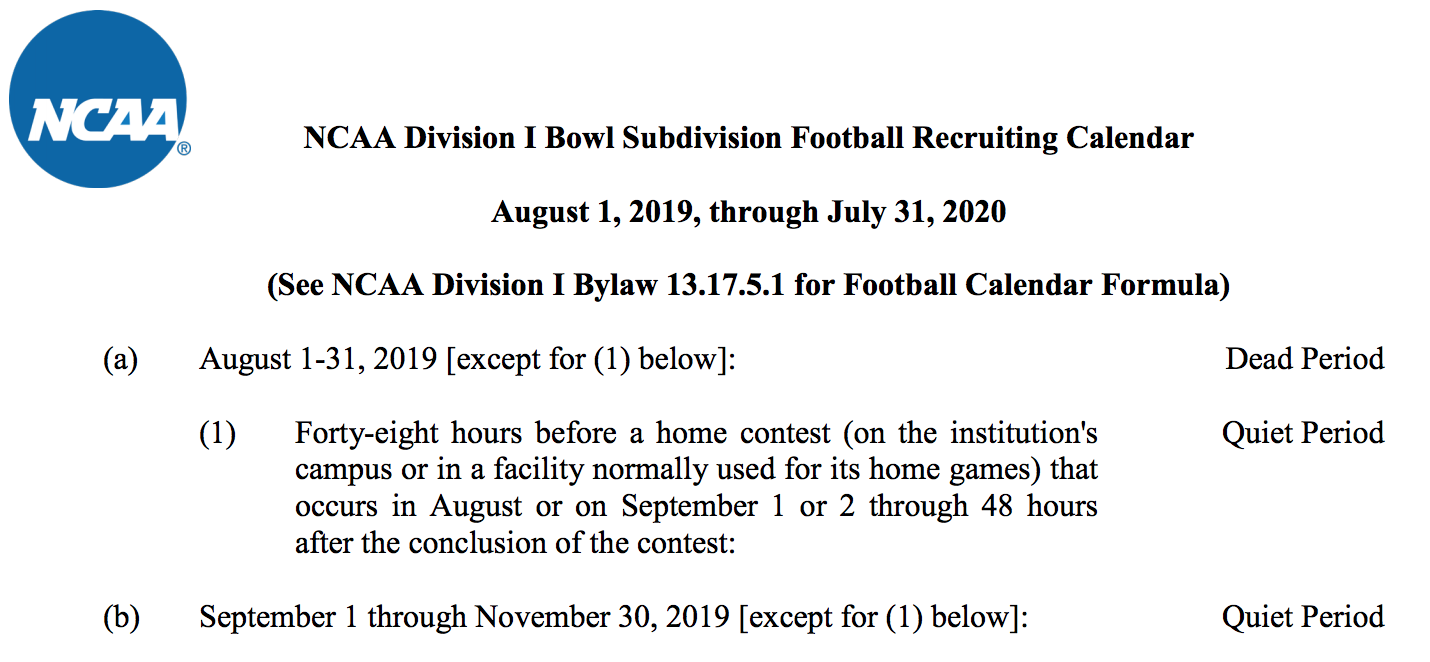
During the Fall, and after the window of the contact period closes, it is very important to know what contact period of your sport and the communication regulations that accompany them. This information is easy to locate within the NCAA and NAIA regulations on their respective websites. This information can also be accessed  in your Prepstar profile.
Now, be aware that all divisions (D1, D2, D3, etc) have similar, but different, communication rules. For example, D2 coaches have much more leniency  with communications in comparison to D1 coaches.  Additionally, in football, FBS schools (those that go to bowl games) have similar contact periods but different number of evaluation opportunities.

The key to communicating in the Fall is to be proactive! Throughout the year, and at any time, athletes are permitted to contact coaches. This means that to communicate with college coach outside of designated contact periods, student-athletes have to be the one to initiate contact. Additionally, this rule also applies to underclassmen (Freshman and Sophomores). Again, no matter what time of year and no matter the contact period, college coaches are permitted to talk with prospects as long as the prospect makes the first move to contact them.

So, I highly recommend that student-athletes take the initiative to reach out to coaches with emails, texts and voicemails.  Don’t ever wait for them to call you, instead you call them.

To wrap up, it is an understatement to say that recruiting is a year round process. There is no downtime because college coaches are always recruiting. So use the latter part of year to your advantage. For Fall sports this is a great time of year to get aquatinted with coaches, take visits and build that ever important recruiting relationship. Likewise, student-athletes that play winter or spring sports can use the Fall to as a great opportunity to get on the radar and generate interest from coaches for the upcoming seasons.

Good luck!

Coach Mike oversees the the recruiting of talented next-level athletes to develop a recruiting strategy to get seen, scouted and recruited.  As a coach with over 20 years of experience, and a as former college athlete, Mike now mentors families through the academic, athletic and financial aspects of college recruiting.  

Coach Mike – Email: mwoosley@csaprepstar.com   Office: 805-622-STAR

Recruiting Email Format: essential info to send to college coaches

Communication between athletes and coaches is essential! Absolutely no athletes get recruited without communicating with college coaches. For this reason alone, every athletes should know not only how to communicate but what information needs to be shared with a coach.

coachToday, my goal is provide you some tips on what information needs to be included in an email to a college coach.

To begin, start by emailing a response to the coaches at the colleges you are interested in. Also, when writing the email, keep the email personal, short and sweet.

Next, make sure to always include; First and Last Name, Position, Graduating year, Height (weight optional) and GPA all in the email subject line. Most coaches use email headlines to filter the specific types of athletes they’re looking for.

Use these tips and you will surely get their attention!

Would you like me to send you an email format to use? Leave a note in the comment section or text me at 480-442-6226.


Readers are welcome to leave comments to this week’s post or ask questions to be answered in next week’s post.  As always, I can be reached around the clock on twitter @michaelwoosley.

No Last Minute Miracle Needed- 5 Tips for Athletes Manage College Recruiting

Time Management

Most athletic competitions have time constraints. For example, soccer has two 45 minute halves, basketball four 8 minute quarters, even track and swimming measure placements by time. Baseball and softball limits games by a specified number of innings. Clearly, time management is vital to every game.

Usually the team that did the best job of managing the clock wins the game.  Teams that don’t have to rely on a last minute miracle.  

Last Minute Miracles

Truth is athletes only have one shot at getting recruited.  No one can have a high school do-ver. So athletes in the midst should never rely on a last minute miracle to land a scholarship.

I’m not a miracle worker, but I know how to manage the recruiting clock.  Partnering with me will assure success!

Senior year should be one of recruiting celebration not  recruiting anxiety.

Think of it like this. Would you rather hurry and scurry around as the clock winds down hoping to score at the last second or would you prefer to know that victory is eminent  and relish the moment of celebration?

5 Tips to Enjoy the Recruiting Process (and avoid hoping for a last minute miracle)

Follow these few tips to be certain that you’ve met your goals and victory belongs to you!

  1. Have a solid recruiting plan. Start working the plan early and stay the course. This is where years of recruiting exposure will pay off.
  2. Keep focused in the classroom and on the field. The classroom is not the place to let your performance slip.
  3. Be familiar with the recruiting timeline. Depending on the sport, calls from college coaches for recruiting can begin in June, July and September.
  4. Know communication rules Communicate with as many coaches as possible.
  5. Take official visits to colleges recruiting you. Five official visits are permitted, use them wisely.  Make sure you know the academic and athletic expectations for athletes at each school.

The clock is ticking. Time will eventually run out.  When this happens I want to be sure your family is celebrating!

Be committed, get committed. 

cropped-cropped-main_logo-11.jpg

Coach Mike Woosley is a National Scouting Director at CSA-PrepStar.  As a professional collegiate sports scout Mike works with qualified next level student-athletes to find the right college athletic and academic fit. Comments and questions are always welcome.

Six Details to Include in a Short Email to College Coaches

Athletes that get recruited know that at some point it is necessary to email a college coach. This brief communication is crucial to your recruiting because needs to be short but detailed enough to give the coach enough information to put you on the recruiting radar. So, if writing isn’t your strong-suit or your unsure of what to include this blog will help.

For serious recruitings drafting a recruiting email takes serious effort
For serious recruits drafting a recruiting email takes serious effort

The format I’m sharing with you is great for the initial email to college coaches. However, if a coach contacts you this email will work, but you need to add one extra detail.  That detail is to ALWAYS thank the coach for contacting you. Do this in the introduction of the email. Also its a good idea to include how the coach contacted you. For example,  “Thank you for taking the time to contact me… write me…..email me..send me a postcard…”

Now, on to the 6 important details. Here’s what should be included. 

1. Introduce yourself

  • Name, City, State,

2. Give them some specifics about you

  • graduation year, sport, position, academic interest
  • I attended the [camp/combine] on [date]

3. Tell them something about their program and/or college (some brief research will help )

  • Ex. “Your school has both a great [sport] team but also a top-notch [subject] program”

4. Request information about the college’s athletic and academic programs be sent to your home

  • Ex. “I would like to know more about your athletic program and the academic programs offered at [name of the school]”

5. Include address and phone number in your signature.

  • Name, address, phone

6. Help them connect with you on social media

  • hyperlink your Twitter handle or Facebook profile info at the bottom of your signature.

Again, remember to keep this email short. Its not necessary to be long winded. Truthfully, no more than two paragraphs is necessary.

One other tip. As your recruiting gets more serious a longer email will be necessary. I’ll show you what to include for that email in another blog.

Good luck,

cropped-cropped-main_logo-11.jpg

Coach Mike Woosley is a National Scouting Director at CSA-PrepStar.  As a professional collegiate sports scout Mike works with qualified next level student-athletes to find the right college athletic and academic fit. Comments and questions are always welcome.

Reputation Ruined by a Press of a Button

This week’s tip about social media is very important. So, here’s the tip: coaches pay attention to how athletes present themselves on social media. 

Recently, All-Pro NFL superstar J.J. Watt lectured students on this very topic.  Watts’ wisdom was this, “A reputation takes years and year and years to build, and one press of a button to ruin.” You can find the article here.

Here’s an example of the harm that can’t be undone. Recently, I spoke with an athlete that was kicked off his team because someone in a picture with him was holding an illegal drug. One stupid mistake has sidelined this stellar senior athlete and jeopardized his future. Please, don’t let this happen to you.

Make wise choices to avoid costly decisions.

Social media is a tremendous way to interact with people all over the world and express ourselves in any way we choose. But with great opportunity comes great responsibility.  Here are some important things to keep in mind before you send your message into the great global conversation.

  1. Anyone, anywhere can see your post
  2. Your post speaks for your personality and character
  3. Pictures can speak for the company you keep.
  4. Posts are nearly impossible to erase once its out in cyber-space

To close, I’m not saying don’t use social media. I’m only suggesting that you use it to your advantage. Used properly social media really can make a difference with your recruiting.  So before you press ‘send’ think about the consequences. If you have any reservations for what your about to send, by all means don’t send it!

Be smart with social media.

Coach Mike Woosley

Coach Mike Woosley is a National Scouting Director at CSA-PrepStar.  As a professional collegiate sports scout Mike works with qualified next level student-athletes to find the right college athletic and academic fit. Comments and questions are always welcome.

cropped-cropped-main_logo-11.jpg

#1 recruiting mistake I see most often

As Scouting Director I get to see many of the country’s most talented athletes. As I evaluate, talk and meet with families across the nation and I’ve discovered that a larger number of them struggle with recruiting. I want to share what I’ve found to help you with your athlete’s recruiting.

Most often recruiting struggles have little to do with the athlete’s ability and more to do with timing. The number one recruiting mistake I see most often is related to starting the recruiting process too late.

Because college coaches cannot recruit a player that he/she does not know about you can avoid this mistake by starting the recruiting process early. An early start assures more control over the recruiting process and greater opportunities to be scouted and recruited by more coaches, as well as, saves your family time, money and worry.

everyone-makes-mistakes-the-wise-are-not-people-who-never-make-mistakes-but-those-who-forgive-themselves-and-learn-from-their-mistakes

However, neglecting to start early has severe consequences. The most common are

  • unnecessarily spending of precious time and money trying to make up for lost time,
  • loss of control over the recruiting process
  • no competitive advantage over the thousands of other athletes hoping to fill roster spots and get scholarships
  • athletes that are overlooked and not recruited like they should be

Partnering with PrepStar and myself can assure you the right amount of recruiting exposure and assistance you need to stay ahead of the recruiting game or catch up if you are behind.

I hope this tip is both helpful and useful for your athlete’s recruiting. I’ve included a few recruiting resources are included below to help you out.

~ Coach Mike


Coach Mike Woosley is a National Scouting Director at CSA-PrepStar.  As a professional collegiate sports scout Mike works with qualified next level student-athletes to find the right college athletic and academic fit. Comments and questions are always welcome.

cropped-cropped-main_logo-11.jpg