When creating a recruiting highlight video, the main goal isn’t to show how each game unfolded with a chronological series of plays. Instead, the purpose is to tell the story of why you’re a serious prospect. You do this by showcasing your best position-specific skills and athleticism.
Here are five key tips for assembling a standout recruiting video:
1. Keep the video time between 3-5 minutes 2. Frontload the best plays in the first 30-60 seconds 3. Showcase position-specific skills 4. Keep the focus on you by spotlighting 5. Avoid plays with cheap shots or penalties
Success in high school athletics doesn’t happen by chance—it’s the result of dedication, smart preparation, and consistent effort both on and off the field. To truly stand out, athletes must commit to more than just showing up for practices and games; they need a structured plan for skill development,coaching and feedback. Not to leave out the discipline to care for their bodies and minds- especially during the demands of in-season games and practices.
By focusing on training with purpose, being coachable, and prioritizing recovery and mental preparation, student-athletes can unlock their full potential and position themselves for long-term success in their sport.
1. Commit to Consistent Training and Skill Development Train with purpose: Follow a structured training program tailored to your sport and position.
Master the fundamentals: Build a solid foundation by refining basic techniques before advancing to complex skills.
Cross-train: Incorporate strength, agility, speed, and mobility work to become a more complete athlete.
2. Seek Coaching and Feedback Work with coaches: Regularly ask for input on areas to improve and apply their feedback.
Film review: Analyze game and practice footage to identify mistakes and opportunities for growth.
Be coachable: Maintain a growth mindset and stay open to constructive criticism.
3. Focus on Recovery, Nutrition, and Mental Preparation Prioritize recovery: Get enough sleep, hydrate, and take rest days to allow for muscle repair and performance gains.
Eat to perform: Fuel your body with nutrient-rich foods that support training and recovery.
Build mental toughness: Set goals, develop confidence, and use visualization and positive self-talk to stay focused and motivated.
By staying disciplined in these three areas, athletes can maximize their potential and consistently elevate their performance throughout their high school career.
Understanding NCAA Athletic Scholarships: Headcount vs. Equivalency Sports
When it comes to college athletics, scholarships play a crucial role in helping student-athletes afford their education while competing at a high level. However, not all scholarships are awarded the same way. The NCAA divides sports into two categories: headcount sports and equivalency sports, with different rules for how scholarships are distributed.
Headcount vs. Equivalency Sports
In headcount sports, such as Division I football (FBS), men’s and women’s basketball, women’s gymnastics, tennis, and volleyball, scholarships are awarded on a full-ride basis. This means each scholarship must cover the full cost of attendance, and there are strict limits on how many athletes can receive one.
In contrast, equivalency sports like baseball, track and field, and soccer allow coaches to divide scholarship funds among multiple players. This means that instead of receiving a full scholarship, many athletes in these sports receive partial scholarships, which are often combined with academic aid or other financial assistance.
Scholarships in Division II and Division III
At the Division II level, all sports are considered equivalency sports, meaning scholarships are typically divided among team members. This allows more athletes to receive financial assistance, but most do not receive full-ride scholarships.
Meanwhile, Division III schools do not offer athletic scholarships at all. However, this does not mean that athletes are left without financial support. Many Division III student-athletes receive substantial aid through academic scholarships, grants, and need-based financial aid. In some cases, the financial packages at Division III institutions can be just as competitive as those in scholarship-granting divisions.
For student-athletes and their families, understanding these distinctions can help in making informed decisions about college recruiting and financial planning. Whether aiming for a full scholarship in a headcount sport, seeking partial aid in an equivalency sport, or leveraging academic scholarships in Division III, there are multiple paths to making college athletics an affordable reality.
When it comes to workout recovery for athletes, the difference between EAAs and BCAAs is significant. BCAAs—leucine, isoleucine, and valine—play an important role in triggering muscle protein synthesis and can reduce soreness and provide energy during training. However, because they make up only three of the nine essential amino acids, they are incomplete for rebuilding and repairing muscle tissue.
EAAs, on the other hand, include all nine essential amino acids your body cannot produce on its own. This complete profile not only stimulates muscle protein synthesis but also supports hormone production, energy balance, and prevents muscle breakdown. EAAs provide the full building blocks required for muscle repair, making them the gold standard for post-workout recovery.
Bottom line: BCAAs are helpful during training for energy and soreness management, but EAAs are superior for full recovery, growth, and long-term performance gains.
September 1 of a student-athlete’s junior year in high school is one of the most important dates in the recruiting calendar, especially for Division I and II prospects. On this date, college coaches are officially permitted to begin direct communication with prospective student-athletes. This includes phone calls, emails, text messages, direct messages on social media, and other personal recruiting correspondence. Before this date, coaches are limited in how they can interact with underclassmen, typically only able to send camp invites, questionnaires, or general recruiting materials.
In addition to communication, September 1 also marks the point when athletes may begin receiving recruiting materials and more personalized information from programs. Coaches can start scheduling unofficial and official visits, although the actual timing for when official visits can take place may vary by sport. Prospects may also begin discussing scholarships, roster opportunities, and other program details directly with coaches.
This date is especially significant because it is the first opportunity athletes have to see which programs have genuine interest. For many sports, September 1 serves as the “starting line” for meaningful recruiting conversations and can accelerate the process of narrowing down college options.
Athletes preparing for this milestone should have their highlight film, academic information, and athletic resume updated and ready to share. Being proactive on or before September 1 can make a major difference in attracting coach attention and building early momentum in the recruiting journey.
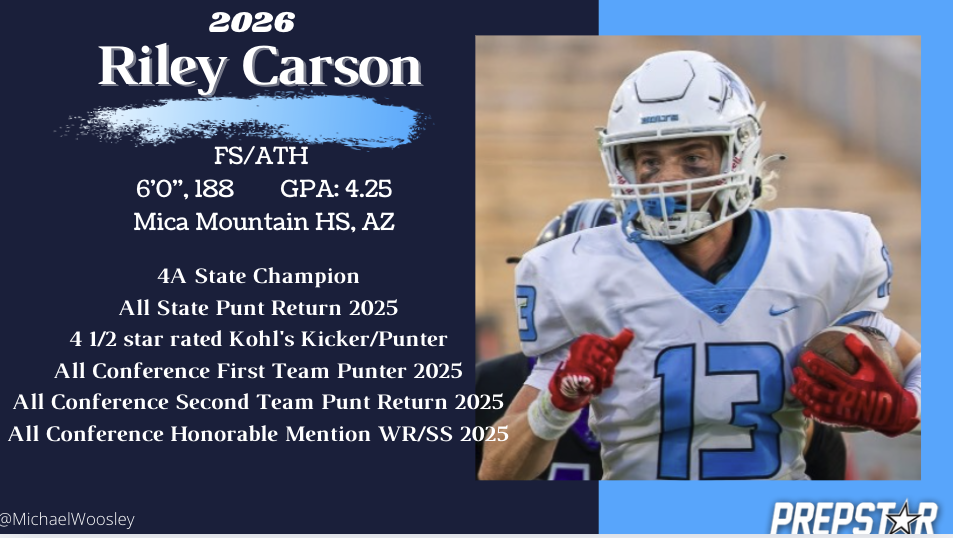
The PrepStar featured athlete for this week is Riley Carson. Riley is a versatile, high-impact player who excels in multiple phases of the game. Carson contributes as a wide receiver and strong safety, demonstrating his athleticism and football IQ. His presence on special teams is elite, where he serves as a punter, kickoff specialist, and punt returner. A key contributor to Mica Mountain’s 2024 4A State Championship team, Riley was also selected All Conference First Team Punter, All Conference Second Team Punt Return, All Conference Honorable Mention Wide Receiver and Strong Safety.
This summer he also picked up offers from Lake Forest, Western New Mexico, Wabash, Minot State and Pacific and was selected for the 2025 Fiesta Bowl All State Selection (Punter). Recently, I caught up with the rising Senior about preparation for the coming season and some memorable moments.
The PrepStar featured athlete for this week is Kaleb Layton. Kaleb is a dynamic quarterback with a strong arm, impressive athleticism, and the ability to make plays both in the air and on the ground. The recent transfer to Buena High School (AZ) Kaleb had a stellar 2024 season, throwing for 1,943 yards, 19 touchdowns, and maintaining a 101.0 QB rating while also rushing for 210 yards and 8 touchdowns. His performance throughout the season earned him multiple Player of the Week honors, including recognition from Tucson ESPN Radio, KVOA News 4 Tucson, the Snoop Dogg Arizona Bowl, and more. Recently, I caught up with the rising Senior about preparation for the coming season and some memorable moments.
What are your goals after high school? To go college and study business and continue my football dream and goals.
Are you looking to play in college? Yes, it’s always been my dream since I was little to play at the next level in college.
What’s your dream school or team? My dream college has been LSU ever since I was a kid. I’ve been watching them from the ups and downs.
What has been your favorite moment in competition? The opportunity to get better, with good competition means that I’m pushing myself to be my best every rep.
What part of the game do you love most? The family that it creates around a group of boys and creating memories with a team that is a part of something special.
What’s the best piece of advice you’ve received? There is always something you can work on or get better at and your biggest competition is always the guy that looks back at you in the mirror.
What’s your pre-game routine / or pre-game superstition? Locker room getting hyped up with my brothers.
If a movie was made about you, who would play you? It would have to be my closest friend because he knows everything about me.
If you could try another sport, what would it be? Yea, I wanna play baseball this year.
What’s your favorite game-day food? Canes. Me and my teammates have always eaten canes before games. It helps us through the game
Many athletes talk with me about how to gain weight and add muscle to their frame, especially during the busy summer activities of camps, practices and workouts. My reply is always to ask if they know how many calories they eat every day compared to the amount of calories they burn every day. Most athletes do not know they answer to either question.
For example, say you have car and enough gas in your tank to get 100 miles. But the trip you are about to take is 200 miles. Obviously, if you don’t add more gas to your take you’ll surely end up stalled out on the side of the road. So, simply, you need more gas to get where you want to go. Likewise, to continue to gain weight and add muscle to their frame athletes should be in a calorie surplus.
I’ve mentioned in articles from previous newsletters that to grow muscle and add weight the body needs surplus calories. Which means that at the end of the day you have consumed more calories than you have burned during an active day. Also, unless you have the time to weigh food and do complicated math to figure out your daily caloric intake I suggest using an calorie counting app, to help you track how many calories you burn daily and how many you need to consume to build muscle effectively.
Take the Initiative — Reach Out to Coaches via Email or Social Media Even though in-person contact is restricted, coaches can still respond to emails, messages, and letters.
Send personalized emails with your highlights, GPA, test scores, and a short message expressing interest.
Follow and interact (appropriately) with college programs on platforms like Twitter and Instagram.
Tip: Include a link to your recruiting profile or highlight video in your message.
Update Your Recruiting Profile and Highlight Video Make sure your Hudl, YouTube, or PrepStar profile is current and polished.
Include your latest stats, updated film, and academic info.
Coaches will often evaluate from afar during quiet periods, so your online presence is critical.
Tip: Pin your best clips first—coaches often only watch the first 30–60 seconds.
Schedule Unofficial Visits and Campus Tours You can visit campuses at your own expense, but coaches can’t meet you in person during the quiet period.
Take a self-guided tour and get a feel for the campus environment.
Snap a picture in school gear and tag the program to show your interest (it keeps you on their radar).
Tip: Check each school’s recruiting calendar to ensure your visit aligns with NCAA rules.
The PrepStar featured athlete for this week is Caden VanWinkle. Caden is a dual-position, dual-sport athlete from Mica Mountain High School in Tucson, AZ. He is considered among the top snappers in the state of Arizona and ranked as a 4.5 Star by Rubio Kicking. When he is not snapping for the special teams unit, Caden is getting dirty in the trenches as an offensive linemen. After the 2024 season VanWinkle was selected 2nd Team All Region. He is also an Honor Roll student and a member of the wrestling team. This summer he picked up his first D1 offer from UTEP (University of Texas El Paso). Recently, I caught up with the rising Senior about preparation for the coming season and some memorable moments.