Six Details to Include in a Short Email to College Coaches

Athletes that get recruited know that at some point it is necessary to email a college coach. This brief communication is crucial to your recruiting because needs to be short but detailed enough to give the coach enough information to put you on the recruiting radar. So, if writing isn’t your strong-suit or your unsure of what to include this blog will help.

For serious recruitings drafting a recruiting email takes serious effort
For serious recruits drafting a recruiting email takes serious effort

The format I’m sharing with you is great for the initial email to college coaches. However, if a coach contacts you this email will work, but you need to add one extra detail.  That detail is to ALWAYS thank the coach for contacting you. Do this in the introduction of the email. Also its a good idea to include how the coach contacted you. For example,  “Thank you for taking the time to contact me… write me…..email me..send me a postcard…”

Now, on to the 6 important details. Here’s what should be included. 

1. Introduce yourself

  • Name, City, State,

2. Give them some specifics about you

  • graduation year, sport, position, academic interest
  • I attended the [camp/combine] on [date]

3. Tell them something about their program and/or college (some brief research will help )

  • Ex. “Your school has both a great [sport] team but also a top-notch [subject] program”

4. Request information about the college’s athletic and academic programs be sent to your home

  • Ex. “I would like to know more about your athletic program and the academic programs offered at [name of the school]”

5. Include address and phone number in your signature.

  • Name, address, phone

6. Help them connect with you on social media

  • hyperlink your Twitter handle or Facebook profile info at the bottom of your signature.

Again, remember to keep this email short. Its not necessary to be long winded. Truthfully, no more than two paragraphs is necessary.

One other tip. As your recruiting gets more serious a longer email will be necessary. I’ll show you what to include for that email in another blog.

Good luck,

cropped-cropped-main_logo-11.jpg

Coach Mike Woosley is a National Scouting Director at CSA-PrepStar.  As a professional collegiate sports scout Mike works with qualified next level student-athletes to find the right college athletic and academic fit. Comments and questions are always welcome.

How to make a positive impression during a recruiting interview

4 Things to Know for a Recruiting Interview


Set yourself apart by treating your recruiting visit like you would a job interview

In the coming months many 2017 student athletes will take official college visits to solidify the next steps of their recruiting. It is much like a job interview in many respects. Bosses have reviewed the resume, checked references and decided to scheduled the final interview. So treat your recruiting visit like you would a job interview.

College coaches can now contact 2017 recruits  So if you’re not hearing from college coaches contact me immediately (mwoosley@csaprepstar.com) so I can help you get the recruiting exposure you need to get noticed!

Keep in mind that while your resume is your athletic and academic accomplishments, what’s really going to put you at the top of the list is how set yourself apart during the recruiting interview. So, here are four tips that you need to know to leave a positive impression during a recruiting interview.

  1. Use proper English grammar. Coaches take their job seriously, so it makes sense that they also look to find serious players. Demonstrate that you are articulate and intelligent by using good grammar.
  2. Dress for success. Leave the warm-ups at home. Dress nicely and wear a tie. Don’t worry about standing out. That’s what you are there for, after all!
  3. Separate yourself from the pack. When everyone else is goofing off, keep in mind that the reason you are there is get noticed and get a scholarship!
  4. Answer questions confidently. Rehearse your responses to questions that a coach may ask. Anticipate questions that revolve around your strengths, weaknesses, concept of team, individual goals, work ethic, and responsibility.

Remember, the objective of the recruiting interview is impress the coach so you move up the recruiting board and ultimately increase your chanced to get scholarships.  Follow these tips and you’ll be well on your way to a successful recruiting interview.

Good luck on your upcoming interview!

Coach Mike Woosley


Coach Mike Woosley is a National Scouting Director at CSA-PrepStar.  As a professional collegiate sports scout Mike works with qualified next level student-athletes to find the right college athletic and academic fit. Comments and questions are always welcome.

cropped-cropped-main_logo-11.jpg

#1 recruiting mistake I see most often

As Scouting Director I get to see many of the country’s most talented athletes. As I evaluate, talk and meet with families across the nation and I’ve discovered that a larger number of them struggle with recruiting. I want to share what I’ve found to help you with your athlete’s recruiting.

Most often recruiting struggles have little to do with the athlete’s ability and more to do with timing. The number one recruiting mistake I see most often is related to starting the recruiting process too late.

Because college coaches cannot recruit a player that he/she does not know about you can avoid this mistake by starting the recruiting process early. An early start assures more control over the recruiting process and greater opportunities to be scouted and recruited by more coaches, as well as, saves your family time, money and worry.

everyone-makes-mistakes-the-wise-are-not-people-who-never-make-mistakes-but-those-who-forgive-themselves-and-learn-from-their-mistakes

However, neglecting to start early has severe consequences. The most common are

  • unnecessarily spending of precious time and money trying to make up for lost time,
  • loss of control over the recruiting process
  • no competitive advantage over the thousands of other athletes hoping to fill roster spots and get scholarships
  • athletes that are overlooked and not recruited like they should be

Partnering with PrepStar and myself can assure you the right amount of recruiting exposure and assistance you need to stay ahead of the recruiting game or catch up if you are behind.

I hope this tip is both helpful and useful for your athlete’s recruiting. I’ve included a few recruiting resources are included below to help you out.

~ Coach Mike


Coach Mike Woosley is a National Scouting Director at CSA-PrepStar.  As a professional collegiate sports scout Mike works with qualified next level student-athletes to find the right college athletic and academic fit. Comments and questions are always welcome.

cropped-cropped-main_logo-11.jpg

How social media can help your recruiting

Social media can help with self-promotion

Social media can be a great tool for self promotion for your recruiting. I use it everyday to promote players, share ideas, tips and motivational coaches quotes. On several occasions college coaches have connected with me via social media to ask about my PrepStar athletes.

Social media can also help you connect with coaches, player and key people at prospective colleges. Here’s why.

Many college coaches use social media as another recruiting tool. For them, its a good way to find out what kind of person you are just by viewing your social media pages, posts and interactions.

Screen Shot 2015-06-26 at 12.33.10 PMTwo Reasons to Use Social Media

So, if you don’t have a social media account I recommend that you get one soon. Here are two good reasons a why.

First, social media is a great way to start and keep a recruiting relationship going. But what about the email? Emails definitely have a place in recruiting.  However, connecting with a coach via social media can open the door of opportunity to send the email to tell the coach more about you.  Also, social media is a good way to stay in touch after you’ve gotten to know one another.

Second, NCAA guidelines are a bit vague on the contacting athletes through social media. Texts and emails on the other hand are more regulated and count as a recruiting contact. Use loophole to your advantage advantage.

Lets Review Some Basics

Now, if you want to use social media like Twitter and Facebook to your advantage let’s cover a few basics. Follow these tips and you’re sure to help you use social media to your advantage.

  1. Connect with coaches follow teams to learn about program
  2. Follow college players to collect information, get to know them and learn about the program.
  3. Make your posts interesting. If you put a link, give your follower a reason to want to click the link and find out more about you.
  4. Be wise with the content you post. Don’t post profanity, vulgar or offensive material. And if its on your page delete remove it now!  You want to post content that presents you in a positive way.
  5.  Its not smart to post injuries, failures and absolutely no whining/complaining about a coach or teammates!

    Are you crying? There's no crying in baseball!
    Are you crying? There’s no crying in baseball!

Okay, now that you’ve decided to use social media to your advantage use the social media search menu and started connecting. Also, if you haven’t already, make sure to connect with me on Twitter @michaelwoosley.

Next week, I’ll share some tips on how to get the most out of your social media communications.

Good luck!

cropped-main_logo-12.jpg

Coach Mike Woosley is a National Scouting Director at CSA-PrepStar.  As a professional collegiate sports scout Mike works with qualified next level student-athletes to find the right college athletic and academic fit. Comments and questions are always welcome.

The Courtship of College Recruiting


This summer my wife and I will mark our 18th year of beginning together (married for 16 years).  Believe it or not, however, when I first met my wife she did not immediately start dating me. It’s hard to imagine, I know, but we went through several months of courtship before we committed to dating exclusively. Dating and recruiting are a lot alike. There is always a period of time that it takes for a coach and player to get to know one another before making a formal commitment to spend the next 4 years together.


During the recruiting process the relationship developed between a player and coach leads to great commitment.


So, how does dating relate to recruiting?  I’ve outline three steps to communication to grow a solid player/coach recruiting relationship. During that time lots of communication should happen to grow the relationship. Take note, because there are several similarities in process of getting to know the person you’re going to be committed to for the next 4 years.


The first step is to get to know one another. Whether its text, email, Instagram, Twitter, Facebook or SnapChat athletes and coaches need to communicate with one another. Don’t be timid! Healthy relationships grow out of quality conversations. Its okay to be forward, often a coach expresses his/her interests first starting the recruiting communication process by contacting an athlete, viewing their profile or sending an athlete (or family) written correspondence.


The second step is to ask questions. You should ask questions to get the information you are looking for. Keep in mind that you are interviewing a coach, just as much as the coach is interviewing you. Your decision to accept a scholarship offer is contingent on the answers to your questions. Also, keep in mind, coaches solidify relationships by making scholarship offers to players they are comfortable with and confident in.


The third step is to schedule a meeting. Eventually the time will come to decide whether or not to take the relationship to the next level. Real dates happen face to face, not via technology, so its necessary that a time to meet is scheduled. This can be a campus visit, camp, or meeting at your school/home. Point is the communication you’ve had with the coach will determine the chemistry (or lack of) at the face to face meeting.


Lastly, always keep in mind that every relationship takes time. So my advice to you is to give yourself plenty of time to start and grow that relationship. This is a vital because we are well aware that relationships that happen in a hurry often end in a hurry. If you want the relationship between you and your coach to last, you need to invest the time necessary to assure that it will last.


Coach Mike Woosley is a National Scouting Director at CSA-PrepStar.  As a professional collegiatecropped-main_logo-12.jpg sports scout Mike works with qualified next level student-athletes to find the right college athletic and academic fit. Comments and questions are always welcome.

← Back

Thank you for your response. ✨


New Rule Changes Supports HS Football Players’ Safety

629px-1909_Tyee_-_football_illustration_2Player safety has been a recent hot- button issue at all levels of organized football and the NFHS wasted no time by making some significant rule changes for 2015. A recent study found that high school football players, are twice as likely than college football players to suffer a head trauma (i.e. concussions). Though high-school football is the most popular boys sport, injuries as a whole are a threat to the game and in some locations have led to an exodus where some football programs are now unable to field a team.

This past January the National Federation of State High School Associations (NFHS) Football Rules Committee modified three previous rules to address player safety. Additionally, two rule changes provide further clarification to already established rules and one new rule in regards to series of down has been added.

Here’s a summary of the six rules modified for the 2015-2016 season.

  1. Rule 9-4-3g. No player or non-player shall make any contact with an opponent, including a defenseless player who is not in the vicinity of the ball, which is deemed unnecessary or excessive and which incites roughness.
  2. Rule 2-20. Spearing is now defined as “an act by any player who initiates contact against an opponent at the shoulders or below with the crown (top portion) of his helmet.
  3. Rule 6-1-4 is a new rule. It was added to state that the timing of the foul for not having at least four players on each side of the kicker on a free kick now occurs when the ball is kicked.
  4. Rule 9-4. Beginning next season, an automatic first down will not be awarded for a 5-yard incidental face-mask penalty against the passer.
  5. Rule 10-2-5. New language clarifies that the distance penalty for unsportsmanlike, non-player or dead-ball personal fouls committed by teams can offset. Equal numbers of 15-yard penalties by both teams will cancel and remaining penalties may be enforced.
  6. Rule 5-1-1b is also a new rule. It states that the referee shall have authority to correct the number of the next down prior to a new series of downs being awarded.

Last year 1,093,234 student-athletes participated in 11-man football at the high school level. Hopefully, these new rules will assure the safety of current players and fill more football rosters for the future.

Find the full article here .

Signing Day Is About More Than Signatures

February is a month of important dates. Most dates on the calendar people know; Super Bowl (Feb 1), Valentines’ Day (Feb 14), Presidents Day (Feb 16). But, for most senior student athletes there is one very important day in February … Signing Day!

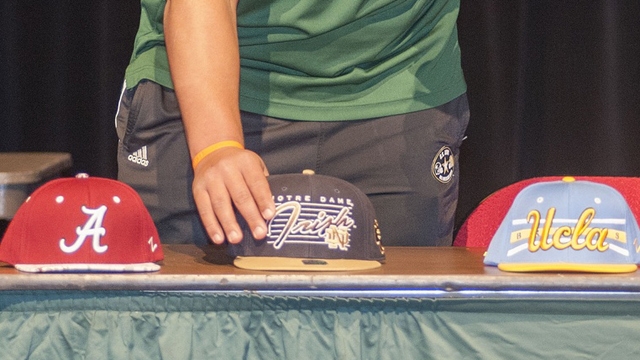
hats-national-signing-day-0205

Signing Day is also known in the athletic world as the day athletes sign their National Letter of Intent. It is the day when verbal commitments between college coaches and student-athletes become solidified thanks to a well executed recruiting strategy.  (Tip- verbal are not binding until you sign on the dotted lines. College coaches and student-athletes are notorious for verbally committing to more than one college or student-athlete..thus the hats:)

Here’s a quick review of the NLI Signing Day

What is a National Letter of Intent?
A National Letter of Intent is signed by a college-bound student-athlete when the student-athlete agrees to attend a Division I or II college or university for one academic year.  Division 3 and Junior Colleges (JUCO) do not have formal signing days (yet). The NLI is a binding agreement between Participating institutions agree to provide financial aid for one academic year to the student-athlete as long as the student-athlete is enrolled in classes and academically eligible for financial aid under NCAA rules.

Off Limits
When a student athlete signs his or her National Letter of Intent ends the recruiting process and competing schools are prohibited from recruiting that student-athlete.

Change Your Mind

Once a student-athlete signs a National Letter of Intent she or he may request a release from his or her contract with the school. If a student-athlete signs a National Letter of Intent with one school but enrolls in a different college or university, she or he will lose one full year of eligibility. To be athletically eligible the student-athlete must complete a full academic year at their new school before being allowed to compete.

Different Signing Days for Different Sports

Signing day varies by sport. The reason for this is because some spring sports like baseball, softball and track do not conclude until after February 4. Signing day for different sports is April 15. I posted the chart to reference.

Screen Shot 2015-01-23 at 6.48.08 PM
Chart provided by the National Letter of Intent homepage

Good luck to all the senior student-athletes signing to play college ball next year at the college or university of their choice.


Coach Mike Woosley is a National Scouting Director at CSA-PrepStar.  As a professional collegiatecropped-main_logo-12.jpg sports scout Mike works with qualified next level student-athletes to find the right college athletic and academic fit.

Some Instruction Required. Making sense of the contact period for hopeful college softball players

Breakdown of recruiting contact period.

takaratomy-qsteer-2
College recruiting regulations can be hard to figure out without someone to help direct you through the process. Sometimes rules need to be defined and broken down so they are easier to understand. One rule is the contact period rule.

Have you ever tried to figure out how to put together something without instructions? This Christmas my son got a remote control car from Santa (;0 ) but it didn’t work right out of the box. Some assembly was required. Disappointed, I looked in the box no instructions were to be found. To say the least, it was a bit frustrating. Where do the batteries go? What were the extra wheels for? And why weren’t the remote commands and combinations noted? Without the instructions to direct us my son and I had to figure it out on our own.

High schools softball players, do you know that today, January 2 begins the college recruiting contact period? Are you aware of the guidelines that college coaches must follow as they try to recruit you?  If you’re as confused about recruiting as I was trying to put that child’s toy together, then this blog is for you! Here’s a breakdown of what the contact period is, what coaches can do and who can be evaluated during this time.

College Recruiting Contact Period

By definition provided by the NCAA Guide for College-Bound Student Athlete, a for D1 prospective student-athletes contact period is the time frame where, a college coach may have in-person contact with an prospective student-athletes and/or his or her parents on or off the college’s campus. The coach may also watch prospective student-athletes play or visit their high school. Athletes and parents may visit a college campus and the coach may write and telephone prospective student athletes during this period.*

College recruiting regulations can be hard to figure out without someone to help direct you through the process. Sometimes rules need to be defined and broken down so they are easier to understand. One rule is the contact period rule.

Breakdown of the rule

So what does that mean? Here’s the breakdown in simple terms.

  • Basically, the contact period is the only recruiting period where a college coach can both evaluate and communicate with a player.
    • This is important to know because other recruiting periods have greater contact restrictions.
  • PSA’s and coaches can talk to one another on or off campus.
    • Specifically Junior and Seniors
  • Coaches can evaluate players by watching games or practices.
    • This includes underclassmen as well. Its a great opportunity to catch a coaches eye!
  • Contact with PSA can be made through phone, letter, email, text, and social media.
    • Underclassmen will only receive school info as noted in my previous blog.
  • PSA’s can take unofficial and official college visits during the contact period
    • Mostly, upperclassmen take advantage of the allotted visits.

A few other important notes. Contact periods are the least restricted of of the four recruiting periods. For many juniors and senior athletes this is also time where scholarship are offered, agreements are drawn up and athletes make commitments to colleges.

Lastly, if all of this is as confusing to you as instructions printed in Korean feel free to reach out to me by leaving a question in the comment section or finding me on twitter @michaelwoosley.

cropped-main_logo-1.jpgCoach Mike Woosley is a National Scouting Coordinator at CSA-PrepStar. As a professional collegiate sports scout Mike works with qualified next level student-athletes to find the right college athletic and academic fit.

How to Enjoy the Recruiting Experience Your Senior Year

Almost every athletic competition has time constraints. For example, soccer has two 45 minute halves, basketball four 8 minute quarters, even track and swimming measure placements by time. Baseball and softball limits games by a specified number of innings. Clearly, time management is vital to every game. Usually, the winning team at the end of the game is the team that managed the clock best. In contrast, the team that does not always relies on last second miracles to pull out the victory.

Last Minute Miracles

Athletes in the midst of their senior year should not rely on last minute miracles to land a scholarship. Now don’t get me wrong, I believe that miracles happen, but I’d much rather be confident that everything has been done to assure that victory is certain. Think of it like this. Would you rather hurry and scurry around as the clock winds down hoping to score at the last second or would you prefer to know that victory is eminent as you take a knee allowing time expire and relish the moment of celebration?

Senior year should be one of recruiting celebration not  recruiting anxiety.
Senior year should be one of recruiting celebration not recruiting anxiety.

Often, I speak with parents and athletes who didn’t take the time earlier in high school to design a recruiting plan. For many reasons these folks are in a panic. Each day anxiety builds up more and more because they are aware that the clock is winding down; the phone’s not ringing, no letters are in the mailbox, and no coach’s emails in the inbox. Truly, I feel for these folks because a miracle is the only hope they have for a scholarship offer.

Tips to Enjoy the Recruiting Process Senior Year.

Senior year is supposed to be an enjoyable year, not one of anxiety.  Follow these few tips to be certain that you’ve met your goals and victory belongs to you!

  1. Stay true to your recruiting plan. Start working the plan early and stay the course. This is where years of recruiting exposure will pay off.
  2. Keep focused in the classroom and on the field. This is not the time to let your performance slip.
  3. Be familiar with the recruiting timeline. Depending on the sport, calls from college coaches for recruiting can begin in June, July and September.
  4. Know that you can contact college coaches. If they haven’t called you, then you call them. Communicate with as many coaches as possible. Show them that you are interested.
  5. Take official visits to colleges recruiting you. Five official visits are permitted, use them wisely.  Make sure you know the academic and athletic expectations for athletes at each school.

NIL Signing Day

When its all over, the goal is to sign your letter of intent in February. Circle this date on your calendar. National Letter of Intent signing day is always the first Wednesday in February. Also note that the NCAA has 346 D1 member schools, 291 D2 and 439 D3 schools all with athletic programs! Many of these programs will not complete recruiting athletes until well into the Spring.  Some Spring sports however have extensions, such as softball and baseball. Due to later season play, regular signing period for these sports are typically April 16 through May 21 for Division I athletes. For Division II athletes the regular signing period is April 16 through August 1st.

Want to receive the Elite Athletes blog as your email? Simply click on the follow button above.

Readers are welcome to leave comments to this week’s post or ask questions to be answered in next week’s post.  As always, I can be reached around the clock on twitter @michaelwoosley.

Score Junior Year When the Recruiting Plan Begins to Comes Together

As a young boy I was a big fan of the A-Team. Regardless of the challenge that faced them, the A-Team Ateamalways overcame the odds finding success in the plan. I will forever be reminded of that show when I hear the famous line, “I love it when a plan comes together!” Any good plan will come together with the right execution.

In the sports world coaches talk a lot about execution. Good execution requires that you step up to your responsibility and deliver results. In the timeline of recruiting, the Junior year is when the execution of your recruiting plan should begin to come together.

The challenge to execute the recruiting plan for every hopeful college athlete can be daunting. Similar to the pressure of hitting that last second shot, driving in the game winning run, or rushing against the clock to score the game winning touchdown. But, a well prepared athlete, isn’t flustered. They know that hard work,  preparation and planning has prepared them to accomplish any objective. So when you’re number is called, you relish the pressure to score one for your team!


SCORE

These tips are sure to help you SCORE that scholarship.

Stay focused on academics by scheduling to take the ACT and SAT test no later than the spring.

Create your junior season highlight video that should include your updated skills video along with quality live game footage

Only send your profile and recruiting video to colleges that match your competitive, geographical and academic interests.

Register with the NCAA Eligibility Center and complete the amateurism certification questionnaire (www.eligibiltycenter.org).

Engage interested coaches by planning to attend sport specific camps and combines.


Bring about Victory

You’re number has been called to execute the plan and bring about victory.  The Junior year is when coaches can start to talk scholarship opportunities with prospective athletes. Off campus contact and official visits are permitted for many sports.

Finally, a good plan needs good people to see it through. Don’t hesitate. Contact me to get the help needed to execute your customized recruiting plan. I can be reached around the clock on twitter @michaelwoosley.


~Coach Mike